A Robust and Universal LC–MS/MS Method for Determination of N-Nitrosodimethylamine in Pharmaceuticals Using a C30 Column
Abstract:
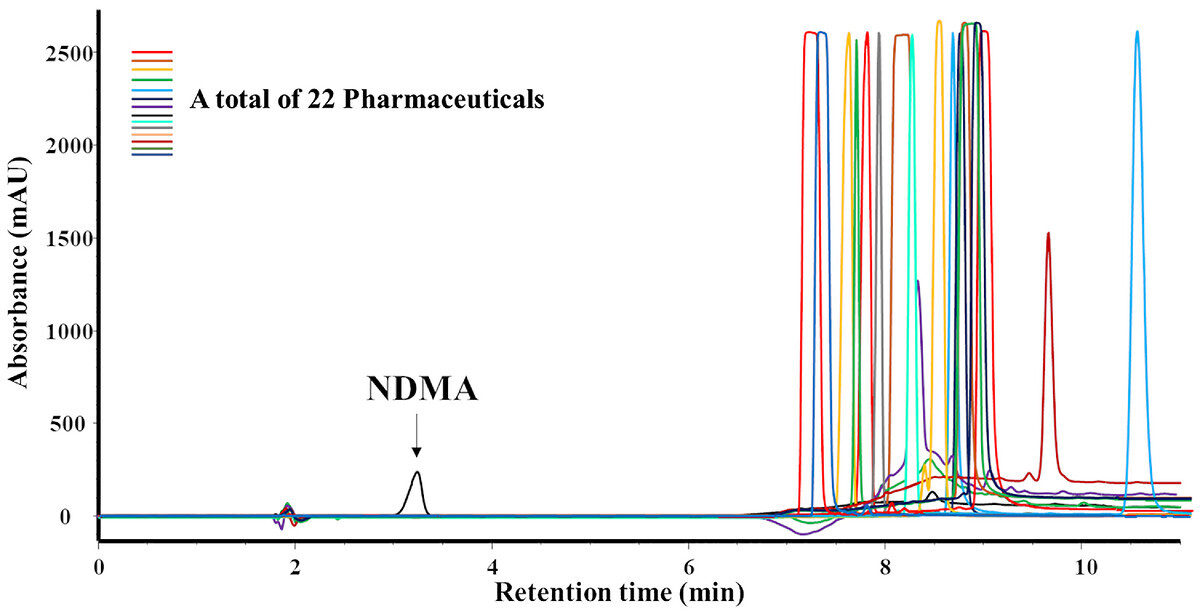
Since the 2018 valsartan recall, the genotoxic impurity N- nitrosodimethylamine (NDMA) has been frequently detected in various pharmaceuticals. Matrix variability often complicates routine testing, requiring customized analyses. We developed a universal LC–MS/MS method enabling consistent NDMA detection across diverse pharmaceuticals. Separation utilized a C30 column (150 mm × 4.6 mm I.D., 5 µm), offering superior retention and shape selectivity for polar nitrosamines compared to conventional reversed phases. Unlike C18 or pentafluorophenyl phases, which often exhibit limited retention for NDMA, the C30 phase provides exceptional shape selectivity and enhanced hydrophobic interactions. This structural advantage, supplemented by its resistance to phase dewetting under highly aqueous conditions further ensures robust resolution between NDMA and complex drug matrices. The mobile phase consisted of 0.1% v/v formic acid in water and methanol under gradient elution at 1.0 mL/min. Detection used atmospheric pressure chemical ionization in positive ion mode. The method demonstrated a linear range of 2.0–100.0 ng/mL (r 2 > 0.999), with a limit of detection of 1.0 ng/mL and a limit of quantification of 2.0 ng/mL. Validation per International Council for Harmonisation (ICH) guidelines confirmed accuracy (87.7%–115.5%) and precision (coefficient of variation, CV ≤ 10.7%). Application to 30 diverse pharmaceutical products, including sartans and ranitidine, showed robust resolution (> 2.0) between the analyte and active pharmaceutical ingredients (APIs). Notably, NDMA was quantified in historical batches of ranitidine (164.83 ± 5.68 ng/mL), nizatidine (10.25 ± 0.52 ng/mL), and amitriptyline (2.28 ± 0.19 ng/mL). While the histamine type 2 receptor antagonists significantly exceeded the acceptable daily intake limit, the remaining 27 products showed no detectable NDMA. These findings highlight the method’s effectiveness for real-world surveillance and the critical risk of post-manufacturing NDMA generation during prolonged storage. This universal C30-based method provides a practical, reliable tool for routine screening, facilitating regulatory compliance and improved patient safety without drugspecific method development.