(T1230-10-58) Evaluation of Mitigation Approaches for Nitrosamine Formation in Binary Blends
Purpose: N-Nitrosamines are a class of potentially mutagenic carcinogens, some of which have been observed in pharmaceutical products. Nitrosamines could possibly form from the nitrite impurities in the excipients reacting with vulnerable secondary amines on the active pharmaceutical ingredient. It is hypothesized that the application of nitrite scavenging film converts the nitrite impurities into non-nitrosating agents, leading to mitigating the nitrosamine formation.
Methods: To test this hypothesis, experiments were designed containing binary blend of lisinopril (LSN) model drug substance and excipients exposed to 75%RH at 60 °C. The influence of water on nitrosamine formation was examined at various (11 to 75%RH) humidity conditions. To minimize nitrosamine formation, various formulation approaches such as coating with SiO2 (R200 (hydrophilic) and R972 (hydrophobic) grades), addition of antioxidants (cysteine (CYS) and propyl gallate (PG) and use of nitrite scavenging films (N-Sorb 36 and N-Sorb 38) Aptar CPS technologies, Auburn, AL, have been explored. N-Nitroso lisinopril (N-NO LSN) was quantitated using Vanquish Tandem Liquid Chromatography (LC) system and a Orbitrap Exploris™ 240 mass spectrometer (MS) (Thermo Scientific™, Waltham, MA) with a retention time of 4.3 min.
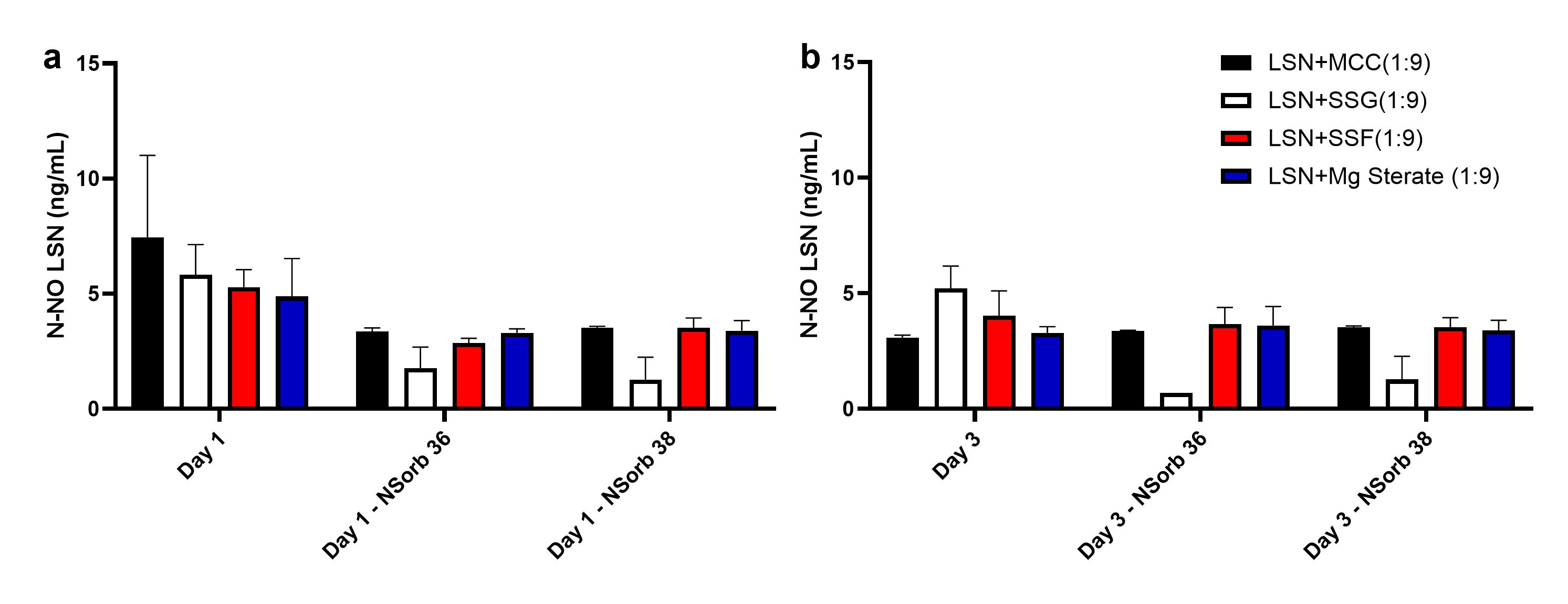
Results: It was observed that there is a good correlation between the relative humidity and the presence of nitrite in the formation of N-NO LSN impurity. The proposed mechanism of nitrosamine formation entails the following sequence: sorption of moisture by excipients to form a saturated solution layer → followed by dissolution of lisinopril → thereby facilitating the nitrosation reaction. The first mitigation approach, coating of LSN with SiO2 R200 and R972 grades resulted in more than 1.5 folds higher N-NO LSN formation. The second strategy, i.e., addition of CYS and PG antioxidants, displayed slight reduction (~ 20%) in nitrosamine formation. Finally, the nitrosamine impurity formation was significantly reduced in the presence of N-Sorb 36 and N-Sorb 38 films. The results demonstrated approximately 80% potential reduction of nitrosamine formation on day 3 with N-Sorb 36 films.
Conclusion: The nitrite scavenging films indicated a significant reduction in the nitrosamine formation as compared to widely used coating agents and antioxidants. This strategy offers an innovative solution to address the growing demand for nitrosamine remediation in the pharmaceutical industry.
Figure 1 Effect of nitrite scavenging films (N-sorb 36) on N-nitroso lisinopril formation in binary LSN-excipients blends at 60 °C/75%RH