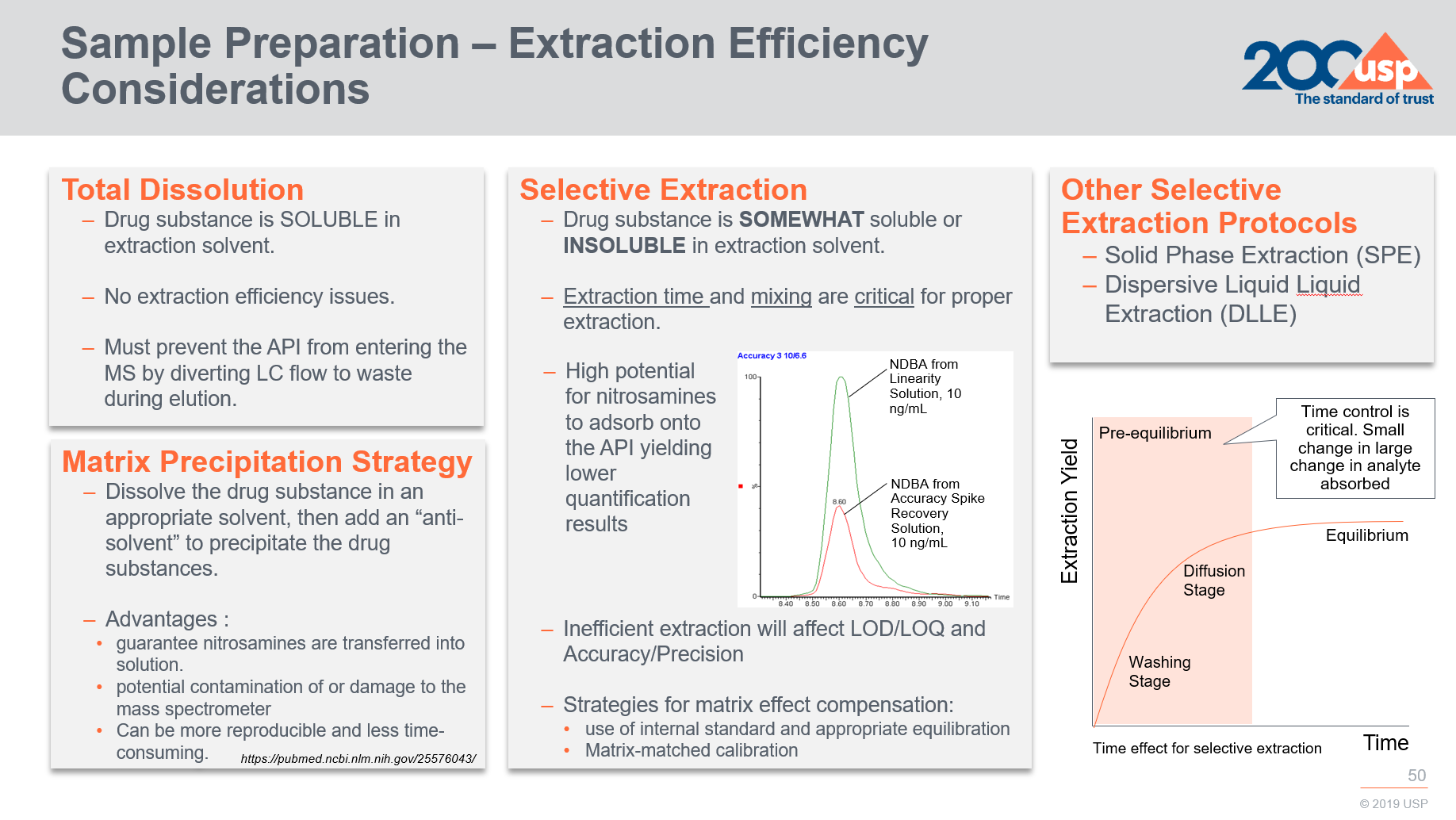
We are developing a method for small molecule nitrosamine in formulation (Tablets). We have selected a diluent (Organic solvent) in which impurity is freely soluble, however the API & formulation excipients are insoluble in the diluent. We are getting the recovery for the impurity by spiking method as well as by standard addition method. We would like to know whether we can use this diluent for analysis even if my API is insoluble/partially in the diluent? or is it necessary to use the diluent where API is completely soluble for analysis of small molecule nitrosamines?
I tend to spike a small portion (for example 100µL) and let the solvent evaporate prior to extraction. With this you can better simulate the performance of your method. However this scratches only the surface of “true” extractibility.
If API and Nitrosamine have different chemical proporties it is smart to use a solvent in which the API does not dissolve. You will have fewer Matrixeffects and fewer artifacts.
Sample extraction and recovery is essential in your analytical development and validation. There are many options, and as nitrosamine already taught us… there is no universal approach.
If you’d have (you likely do not, as I assume) an API “naturally” incurred with nitrosamine, that would help to get an exact answer.
As was noted by Phil, it is reasonable to use the solvent in which the nitrosamine does dissolve, but API does not. However, there is a (quite small, I think) probability that target molecule can be trapped by API.
Maybe, if sensitivity requirements allow, matrix precipitation (see the slide posted above by Naiffer) will be a simple and reliable option.
From what I have heard from an experienced expert in nitrosamine analysis, the key points are to firmly control specificity and stability in solution. Here, “specificity” likely also encompasses accuracy (trueness). If there is analytical interference, it often affects either specificity or stability in solution.
Phil’s approach is excellent in that it takes into account the limitation that spiking standard solutions does not adequately evaluate extraction. However, in practice, it may be reasonable to accept that this does not fully replicate real drug product conditions and proceed with accuracy verification, spiking standard solution addition, without overemphasizing this limitation.
We are performed the spiking by both the methods i.e. 1) By spiking small quantity of standard stock on powdered sample, adding diluent and then mixing & 2) by reconstituting the powdered sample with standard solution. In both way we could achieve the recoveries between 90% to 110%.
I would also like to raise an additional question regarding this topic. Without dissolving the API, how can we ensure that potential small-molecule nitrosamines present within the API are sufficiently extracted into the solvent phase? In particular, I believe that 5 minutes of sonication or a few minutes of vortex mixing may not be sufficient to achieve complete and effective extraction.