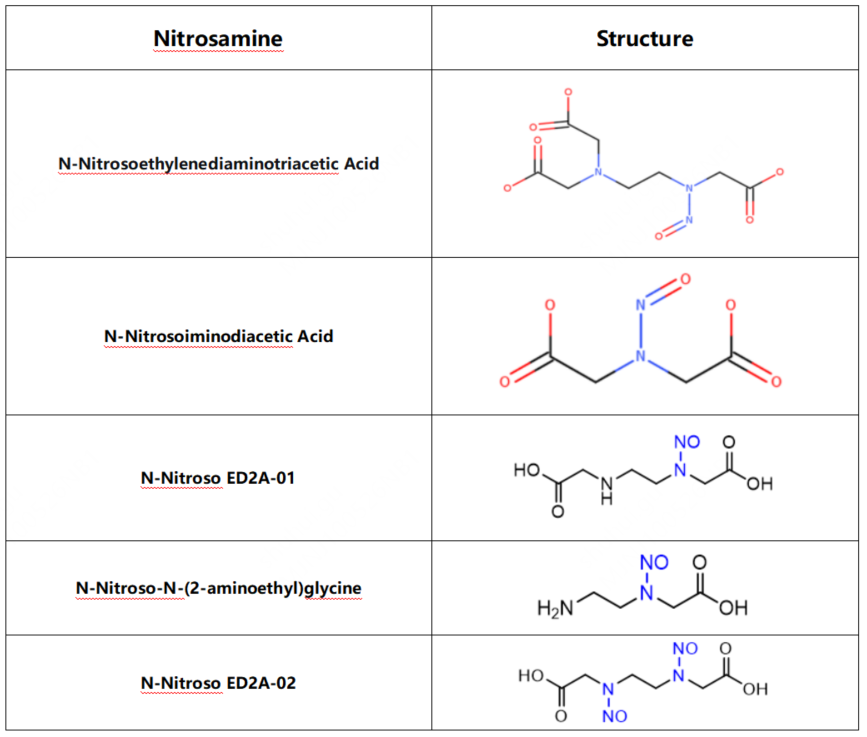
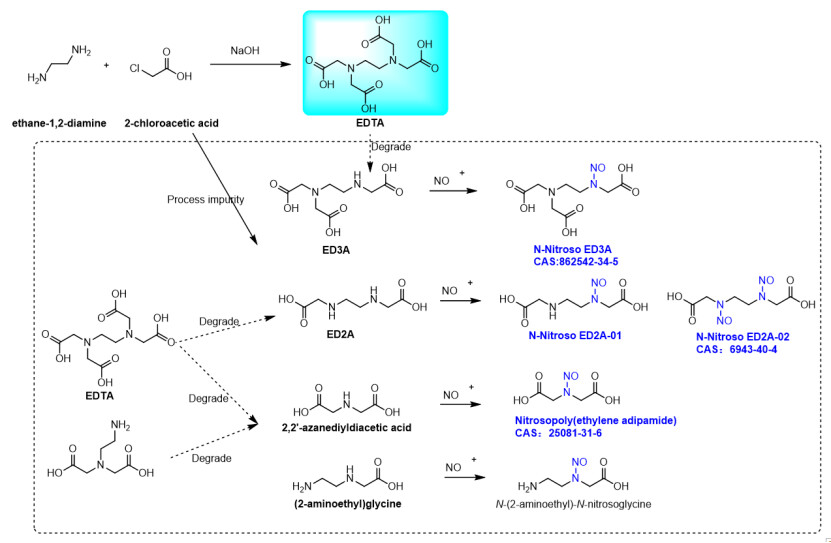
EDTA (ethylenediaminetetraacetic acid) is a classic chelating excipient widely used in ophthalmic solutions, injections, and contrast agents. It stabilizes formulations by efficiently binding metal ions (Ca²⁺, Mg²⁺, Fe³⁺) and preventing metal-catalyzed oxidative degradation.
However, with increasing regulatory scrutiny from NMPA/FDA/EMA on nitrosamine impurities, EDTA has become a concern. Under acidic conditions and in the presence of nitrosating agents (e.g., nitrites), EDTA can form drug-related nitrosamines (NDSRIs) – specifically EDTA-derived nitrosamine impurities.
Based on industry experience, we have identified two major pain points in the study of EDTA-related nitrosamine impurities:
 Pain Point #1 – Reference Standards: Hard to Distinguish Authentic from Fake
Many commercially available EDTA nitrosamine reference standards suffer from poor characterization and incomplete documentation. The risks are real:
-
Missing documentation – Only a CoA is provided, without supporting structural evidence.
-
Incomplete data – NMR and MS results look “compliant”, but no raw or interpretable data are supplied to confirm the structure.
-
MS mismatch – The reported MS data do not match the correct mass of the target compound.
-
Lack of accountability – Some suppliers only defend with “NMR confirms structure”, without providing actual evidence or responding to technical queries.
The synthesis of EDTA nitrosamine reference standards is complex and quality control is challenging. To cut costs, some vendors sell poorly characterized products, labeling only a purity value, while the actual analytical data are distorted or unreliable.
 Pain Point #2 – Low & Inconsistent Content: Quantitative Analysis Becomes Impossible
Even when a reference standard is claimed to have a certain purity, the actual content of EDTA nitrosamine impurities is often far lower than stated in the CoA. This is not an isolated case.
-
Inaccurate reference standards lead to false analytical results and misjudgment of limit exceedance.
-
Project timelines are delayed, and unnecessary R&D risks are introduced.
When the standard itself is wrong, reliable quantification is impossible.
 Conclusion
EDTA-related nitrosamine impurities require urgent attention in drug development and regulatory filing. However, the lack of authentic, well-characterized reference standards – and the widespread issue of low actual content – are undermining analytical accuracy and compliance.
We hope this post raises awareness and encourages the community to push for higher-quality standards and transparent data sharing.