EMA proposes GMP update to EudraLex to address nitrosamine impurities

On 9 February, EMA, with the support of its GMP inspectors working group (IWG), proposed updating the EudraLex Annex 15 requirements for manufacturing qualification and validation based on what the agency had learned about nitrosamine impurities in a 2020 report. The findings of that report, which was co-published with the Heads of Medicines Agencies (HMA), found that active substance manufacturers lacked sufficient process and product knowledge during their product development stage to take steps to prevent the contaminations.

The proposed update would make it mandatory for active substance manufacturers to comply with the requirements in Annex 15, including those regarding validation master files, qualification and validation policies, and change control.

5 Likes

Thanks @Yosukemino this is a major development and important advancement for Nitrosamines prevention … I believe Japan placed the seed for this when started demanding detail information from API suppliers through their questionnaire.
Is this a major shift on regulatory oversight on API suppliers?

1 Like

Sharing the article text here because I had problem this morning to open the link

EMA proposes GMP update to EudraLex to address nitrosamine impurities

Regulatory NewsRegulatory News | 09 February 2026 | Ferdous Al-Faruque

EMA headquarters in Amsterdam. (credit: Ferdous Al-Faruque)

The European Medicines Agency (EMA) has proposed expanding Annex 15 of the EU EudraLex to make it mandatory for all chemical and biological active substance (AS) manufacturers in a concept paper. The update is intended to address nitrosamine impurities found during the manufacturing of sartan medications.

In recent years, there’s been concern about nitrosamine impurities found in sartans, or angiotensin II receptor blockers (ARB), often used to treat hypertension, heart disease, and kidney disease. Nitrosamines have been associated with an increased risk of cancer, and stakeholders in Europe, including regulators and researchers, have proposed more stringent good manufacturing practice (GMP) requirements to address the problem.

On 9 February, EMA, with the support of its GMP inspectors working group (IWG), proposed updating the EudraLex Annex 15 requirements for manufacturing qualification and validation based on what the agency had learned about nitrosamine impurities in a 2020 report. The findings of that report, which was co-published with the Heads of Medicines Agencies (HMA), found that active substance manufacturers lacked sufficient process and product knowledge during their product development stage to take steps to prevent the contaminations.

The proposed update would make it mandatory for active substance manufacturers to comply with the requirements in Annex 15, including those regarding validation master files, qualification and validation policies, and change control.

“These extensions are expected to improve AS manufacturers practice of defining and documenting the qualification and validation activities when drafting the validation protocol referred in paragraph 12.20 of EudraLex Volume 4, Part II,” said EMA. “The control of a change will be also emphasised as an important part of knowledge management.”

Furthermore, the update would extend the requirements to third-party contractors and require the active substance manufacturer to exercise greater control over outsourced activities. It would also require them to investigate instances where the manufacturing requirements don’t meet predefined acceptance criteria and to extend the concept of User Requirements Specifications and Factory Acceptance Testing/Site Acceptance Testing to the manufacturer.

EMA said the update would further emphasize having a robust process development and clarify concurrent validation expectations.

“Provisions on supplier qualification will be also emphasised,” said EMA. "The extension of process validation activities to process recovery of materials and solvents will be highlighted.

“It will focus the attention on the variables that impact critical quality attributes when drafting process validation protocol and provides guidance on continuous process verification and 57 hybrid approach,” the agency added. "Emphasis on periodic review will be also provided.

Another key aspect of the proposal would provide more clarity of EMA’s expectations when transporting the drugs and biological products, including quality risk management principles set out in the International Council for Harmonisation of Technical Requirements for Pharmaceuticals for Human Use ICH guideline Q9 (R1).

EMA is proposing that the concept paper should be adopted by year’s end and is taking public input on the proposal until 9 April on its website.

4 Likes

Another article from Pink Sheet

Nitrosamine Fallout: EMA Pushes For Stricter Active Substance Manufacturing Controls

Feb 12 2026

• By Vibha Sharma

• 2 min read

The European Medicines Agency and international pharmaceutical inspectorates are proposing to close the gaps in active substance manufacturing that came to light following the detection of cancer-causing nitrosamine impurities in sartan medicines.

Stricter controls on active substance manufacturing can safeguard medicine quality (Shutterstock)

Key Takeaways
  • A concept paper jointly drafted by the European Medicines Agency and the Pharmaceutical Inspection Convention and Co-operation Scheme (PIC/S) proposes making EU good manufacturing practice (GMP) qualification and validation requirements in Annex 15 mandatory for manufacturers of chemical and biological active substances. At present, these requirements are only mandatory for finished product manufacturers.
  • The proposal is driven by lessons from nitrosamine contamination in sartan medicines, where contributing factors included insufficient process and product knowledge, inadequate investigation of quality issues, and poor contamination control measures at active substance manufacturing sites.
  • The revised Annex 15 is expected to be adopted by December 2026, after which EU and PIC/S inspectorates will ensure its implementation during GMP inspections.

The European Medicines Agency and the global network of pharmaceutical inspectorates, PIC/S, have proposed that manufacturers of active substances be held to the same qualification and validation standards as finished product manufacturers.

The proposal stems from lessons learned from instances of cancer-causing nitrosamine contamination in sartan blood pressure medicines. Contributing factors included inadequate process and product knowledge at the development stage among active substance manufacturers, coupled with deficiencies such as poor investigation of quality issues and insufficient contamination control.

In light of these learnings, the EMA on Feb. 9 proposed extending the scope of Annex 15 of the EU Good Manufacturing Practice (GMP) guideline (ie, EudraLex Volume 4), which currently applies to the qualification and validation of finished products, to also cover the manufacturing of active substances.

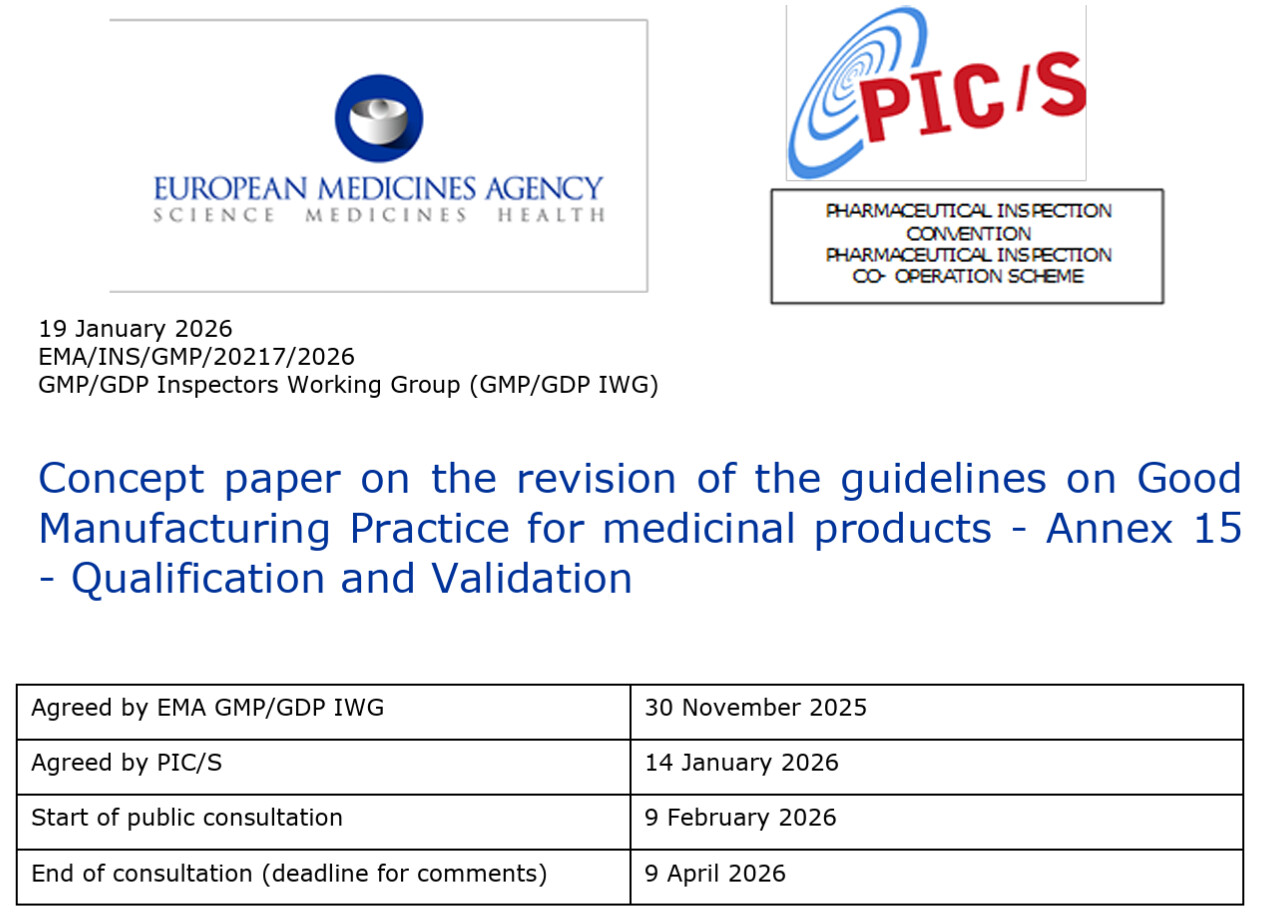
The proposal is outlined in a draft concept paper that the EMA and PIC/S (the Pharmaceutical Inspection Convention and Co-operation Scheme), which aligns its GMP framework with that of the EU, have jointly issued. Stakeholder feedback on the paper is being accepted until April 9.

“Making annex 15 formally mandatory to active substance manufacturers is expected to further enhance public health safety by promoting manufacturers to have more oversight and knowledge about their processes and products,” the paper notes.

The concept paper also proposes amending the Annex 15 text in “selected areas” to supplement and link it with EU GMP guidance on Basic Requirements for Active Substances used as Starting Materials (ie, EudraLex Volume 4, Part II).

In addition, there are plans to align Annex 15 with recent changes to the International Council for Harmonisation’s global quality risk management (QRM) guideline, Q9(R1).

These proposed changes are expected to be finalized and adopted by the EU and PIC/S by December 2026. When they come into effect, the concept paper states that EU and PIC/S inspectorates will ensure they are implemented and complied with during regulatory inspections of the facilities manufacturing chemical and biological active substances.

“For companies already working in line with ICH Q8/Q9/Q10 principles and operating a robust QRM system, this should not be a problem,” said Meenal Godbole of the Netherlands-based consultancy firm Chem4Life. “For others, it is time to make sure development knowledge, validation strategy, change control and ongoing monitoring form a connected lifecycle instead of separate activities,” Godbole noted in a social media post.

Impact On Active Substance Manufacturers

At present, compliance with EudraLex Annex 15 is optional for active substance manufacturers, as it has historically served as “supplementary guidance” rather than a binding requirement. The concept paper recommends making compliance with the annex mandatory for active substance manufacturers by:

  • Expanding the concepts of “validation master file” and “qualification and validation policy” to improve how active substance manufacturers define and document qualification and validation activities in their validation protocols, while reinforcing change control as a key element of knowledge management.
  • Enhancing expectations for validation performed by third party contractors to ensure active substance manufacturers have more control over outsourced activities.
  • Requiring active substance manufacturers to investigate any results that fail to meet pre-defined acceptance criteria and ensure they have a more in-depth knowledge of their processes.
  • Making it necessary for active substance manufacturers to comply with lifecycle-based qualification elements (eg, user requirements specifications, factory acceptance testing/site acceptance testing) – and linking these with design, installation, operational and performance qualification – to strengthen overall process control.
  • Reinforcing the need for robust process development and clarifying expectations for concurrent validation, while also emphasizing supplier qualification. Guidance will also cover continuous process verification, hybrid approaches, and the need for periodic review.
  • Providing clearer guidance on verifying transport conditions to align with good distribution practice requirements, and ensuring that active substance manufacturers consider the impact of transportation in their product knowledge framework and quality assessment.
5 Likes

I am not deeply familiar with EU GMP practice, but my understanding is that Annex 15 has always been applicable in principle to APIs, while in practice API manufacturers mainly operated under ICH Q7 and the lifecycle-oriented expectations were not emphasized to the same extent as for finished products.

From that perspective, the nitrosamine cases starting with the sartans appear to have served as a decisive example showing the limits of traditional validation concepts and highlighting the need for continued process assurance and deeper process understanding also at the API stage.

For those of us who have spent a long time discussing nitrosamines here, it is striking to see how expectations for API control are evolving toward a more science-based, lifecycle approach. Manufacturing APIs with both high quality and high safety assurance is clearly becoming one of the central challenges for the industry. I strongly feel that the paradigm is shifting. :grinning_face:

5 Likes

I hope you all agree, we need a bump in the rigour for excipient manufacturers as well! (Not trying to be controversial!)

9 Likes

Another article I came across this morning…

What does the Concept Paper on Annex 15 Revision say? A detailed Analysis

In the previous newsletter, you could read about a concept paper from the EMA describing the planned changes to Annex 15 (Qualification and Validation) of the EU GMP Guidelines. A detailed analysis is now provided below.

In response to the nitrosamine contamination in sartans, one of the causes identified was insufficient process and product knowledge during development. This prompted the EMA to undertake a further revision of Annex 15 on validation/qualification. The main objective of the revision is to make the inclusion of active substances in Annex 15 mandatory. Until now, it has only been optional for active substance manufacturers. This affects both manufacturers of chemical active substances and biological active substances. The changes in quality risk management included in the revision of ICH Q9 (R1) are also to be incorporated.

What exactly is planned?

The Discussion section provides further details, primarily concerning active substances.

  • The concept of a validation master plan (referred to as a ‘validation master file’ in the concept paper), the concept of a validation policy and the concept of change control are to be extended to active substances. This is expected to lead to improvements among active substance manufacturers with regard to the definition and documentation of qualification and validation activities. This applies in particular to the creation of validation protocols, as described in Part II of the EU GMP guidelines for active substances. Change control is regarded as an important element of knowledge management.
  • More expectations regarding validation by third-party providers are to be included so that active substance manufacturers gain more control over outsourced activities.
  • The need for investigations in the event of deviations from the predefined acceptance criteria is also to be expanded. The hope here is that these expansions will encourage active substance manufacturers to develop a deeper understanding of the process.
  • In addition to the qualification levels DQ, IQ, OQ and PQ already known in the active substance sector, user requirement specifications (URS), factory acceptance tests (FAT) and site acceptance tests (SAT) are now also to be introduced by active substance manufacturers. These measures are also expected to strengthen control over the processes.
  • The changes are also intended to reinforce more robust process development and clarify expectations for concurrent validation. Expectations for supplier qualification are also to be emphasised more strongly. Particular attention will be paid to process validation in the context of the reuse of materials and solvents. When creating a validation protocol, focus will also be placed on variables that have an influence on critical quality attributes. Assistance with continuous process verification and the ‘hybrid’ approach is also to be expected. Likewise, greater emphasis will be placed on periodic reviews.
  • Similar to the verification of transport for medicinal products, this topic will also be included in relation to active substances, taking into account product knowledge and the influence on quality during transport.
  • With regard to monitoring systems, greater emphasis will be placed on quality risk management (QRM) in development and qualification/validation in the revision. There are also plans to provide assistance with QRM with regard to risk reviews in the context of validation and qualification activities. This is also intended to establish a link to Chapter 2 of the EU GMP Guidelines Part II.
  • In future, there should also be a greater emphasis on QRM in traditional process validation.

Further possible amendments to Annex 15

The concept paper further describes the possibility that the Inspectors Working Group and the PIC/S Sub-committee on GMDP Harmonisation, which is also involved, may also take into account other relevant points or changes that arise during the development of the revision.

Comments on the concept paper can be submitted until April 2026. A first draft document on the revision is planned for the end of 2026. The ECA Validation Group will comment the concept paper.

Conclusion: The main focus of the planned second revision of Annex 15 is on the full integration of active substances. Specifications on accompanying validation and quality risk management could also be relevant for drug manufacturers.

2 Likes

Dear Community, @Nitrosamines_Analyzer @Nitrosamines_Explorer @Nitrosamines_Investigator @Nitrosamines_Mitigator @Nitrosamines_Pioneer

I want to bring to your attention an important development from EMA.

In response to the nitrosamine contamination in sartans, one of the causes identified was insufficient process and product knowledge during development. This prompted the EMA to undertake a further revision of Annex 15 on validation/qualification. The main objective of the revision is to make the inclusion of active substances in Annex 15 mandatory. Until now, it has only been optional for active substance manufacturers. This affects both manufacturers of chemical active substances and biological active substances. The changes in quality risk management included in the revision of ICH Q9 (R1) are also to be incorporated.

More information here in the community

-NR

14 Likes

As they say, “Better late than never”. This was long overdue in my opinion.

2 Likes

For me very good decision. I have raised this issue regularly during the Nitrosamine Genotoxic webinars.

1 Like

This is a highly welcome and progressive step by the European Medicines Agency. Making the inclusion of active substances in Annex 15 mandatory will strengthen harmonization and ensure a more consistent application of validation and qualification principles across both chemical and biological manufacturers.

Incorporating the updated quality risk management concepts from ICH Q9 (R1) further reinforces a science- and risk-based approach, which is essential for enhancing product quality, patient safety, and regulatory clarity. Overall, this revision represents a positive advancement for the pharmaceutical industry and supports continuous improvement in GMP practices.

Good step by EMA. Making Annex 15 mandatory for APIs strengthens risk-based validation, change control, and supplier/outsourced oversight. This should help prevent nitrosamine risks and improve inspection consistency and patient safety.

Generally, all Drug Substance manufacturers provide the Nitrosamine Risk Assessment in the Drug Master File (DMF) or Active Substance Master File (ASMF) after the publication of the Nitrosamine Guideline. In any case, if the DMF/ASMF holder is not included in the risk, then the agency raises the deficiency.

Future, Need to check Nitrosamine Risk assessment if there is any change in the following parameters:

Change in the Route of Synthesis/Manufacturing Process

Process Validation performed due to a change in the Starting material/Intermediate Route of synthesis.

If change only the batch size, then, as per my knowledge, no risk is required, but it depends on the DS manufacturer’s process confidence.

1 Like

Thanks for sharing! This actually helps me because I get a lot of pushback from API suppliers and starting material suppliers when I ask for more detailed information in the assessments and mitigation strategies.

3 Likes

Sure thing Naiffer, but not only. As of today, too much focus is placed at API level on nitrosamine contamination, but not on the fact that, if there are no controls for precursor vulnerable amines at nitrosamine relevant concentrations, there will always be increased risks at drug product level! ICH Q3A thresholds are too high

3 Likes