@Yosukemino must be taking a lunch break & I have been able to post this article before him.
Another important article from Rok Gharek & team.
Highlights
•Excipient nitrite levels are not static material attributes.
•Ambient NOx can significantly contribute to nitrite formation and variability.
•Control of process air quality and material handling may be essential for effective mitigation of nitrosamine formation risk.
Abstract
Nitrites in pharmaceutical excipients are a known critical factor for the formation of nitrosamine impurities. The origin and variability of nitrite levels are, however, not yet fully understood. In this study, we investigated the formation and uptake of nitrite in a broad panel of common excipients under controlled exposure to nitrogen oxides (NOx). Our data show that most tested excipients are susceptible to NOx-driven nitrite accumulation, an effect mediated via hydrolysis and disproportionation mechanism. Substantial differences in nitrite accumulation were observed among excipients, governed by their physicochemical properties including pH and specific surface area. Carbonate excipients exhibit the highest absolute nitrite accumulation due to efficient chemical trapping but they also create a less favorable microenvironment for nitrosamine formation due to their basic pH value. In contrast, starch and microcrystalline cellulose (MCC) show only moderate formation of nitrite but potential higher risk for nitrosamine formation due to their high percentage in typical drug formulations and their rather neutral pH. Ambient air exposure studies confirmed that nitrite levels can increase significantly even under laboratory conditions, making environmental NOx a potential contributor to variability in measured nitrite levels. These findings demonstrate that nitrite levels in excipients are no static material atributes but rather dynamic properties potentially influenced by environmental exposure and process conditions. Consequently, control of air quality and material handling can be a tool to mitigate nitrosamine formation risk in pharmaceutical products. Further studies should assess the extent of nitrite uptake of typical formulations under manufacturing conditions involving high air throughput, such as fluid-bed granulation or film coating, to better understand the practical relevance of these findings.
This paper is fascinating - including one revelation that has come as a complete shock (to me at least) and might make me reconsider several things. I’ll not spoil it by saying what it is, I’ll see if anyone else thinks the same.
It may also explain something that we have observed when formulating products, which I was struggling with at the time.
It raises some questions around nitrite values that have been generated for raw materials in the past to me, especially if tested at 3rd party labs etc. What was the material sampled into? Weight versus headspace? How long between sampling and testing. Were the nitrite levels increasing, or even decreasing, between sampling and result generation?
I’m back from lunch. This is another topic I’m very interested in. It is fascinating that nitrite concentration in an excipient is not a static material property—it can change—and that the variability in nitrite levels previously attributed to differences between manufacturers or batches may actually be influenced by a variety of factors, such as the origin of the excipient, manufacturing processes including purification and drying, pH, specific surface area, moisture content, and storage conditions.
It may also be necessary to carefully verify whether the nitrite levels reported in excipients to date have actually been measured accurately.
Thank you for posting. This is truly an excellent paper.
You are so right. As somebody who worked on nitric oxide and nitrosamines, NOx was a daily topic of discussion in Larry Keefer’s laboratory in NCI. I raised this in a European Agency meeting as early as 2020 and they had a tough time believing me. I am happy that people are reinventing the wheel, just hoping that we dont land with a square wheel.
As one of the Authors I would like to emphasize that there is no point in using some low nitrite excipients of the type that are described in the paper if you then place them in a fluid bed dryer without an NOx filter.
thanks @jason.brown for sharing this, If I am not wrong the same/similar concept you also shared over your speech in Aug last week in India (Hyderabad Nitrosamine Conference),
In this regard, I would like to share the presentation materials from Dr. Ulrich Reichert’s talk at the Fiscal Year 2026 Generic Drug Science and Research Initiatives Public Workshop. This makes a lot of sense.
Thank you @Yosukemino
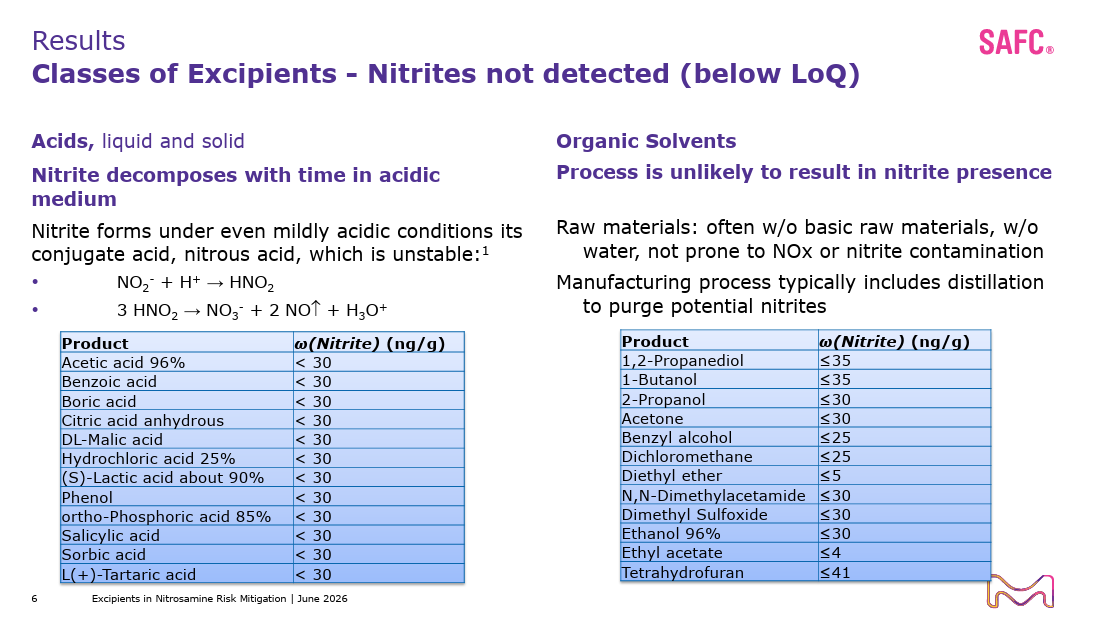
Could you please elaborate whether these excipients are referred as “low nitrite” grade? or it is the common grade ex Merck?
kindly
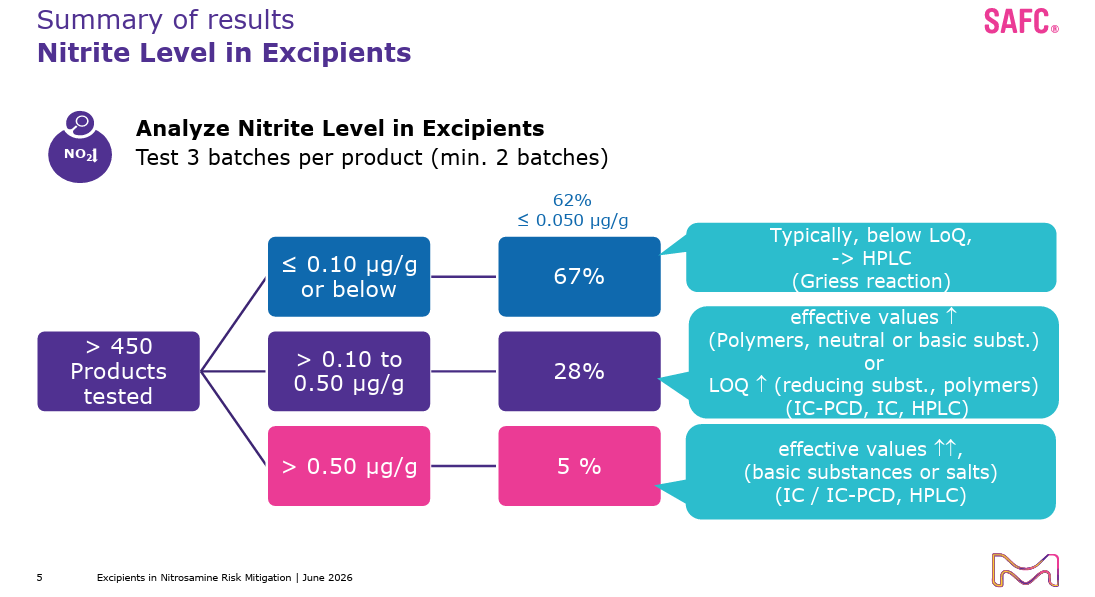
Merck Healthcare KGaA categorized Emprove® products based on nitrite levels. I guess this is the result of the categorization.
We need to keep in mind that some of the 28%(reducing subst. and polymers) are classified as >0.10 to 0.50 μg/g because interference resulted in a higher LOQ.
This paper proposes UV pre-irradiation of pharmaceutical excipients as a novel nitrosamine mitigation strategy, aiming to reduce reactive NOx species present in excipients before manufacturing. It demonstrates that 365 nm UV irradiation significantly decreases the nitrosation potential of several excipients, including MCC, dextrin, calcium phosphate and iron oxides, leading to a 54-68% reduction in N-nitrosodesloratadine formation in tablets. Importantly, the treatment achieved this without affecting tablet physical properties, dissolution performance, or impurity profiles, suggesting a potential alternative or complement to scavengers and low-nitrite excipient sourcing.