Rapid-and-quantitative-screening-of-nitrosamines-in-drug-products-using-headspace-SIFT-MS_V1-v2.pdf (1.8 MB)
Nitrosamine-Analysis-from-Aqueous-Solutions-Using-Headspace-SIFT-MS_Jul-2024_Rev1.2.pdf (1.3 MB)
Selected ion flow tube mass spectrometry (SIFT-MS) for detection of nitrosamines.
Expands the analytical toolkit for the comprehensive detection of nitrosamines using headspace - selected ion flow tube mass spectrometry (HS-SIFT-MS) analysis.
1. Experimental Information
-
Objective/Scope - a partial validation of the headspace-SIFT-MS technique was carried out to assess its ability to meet the recommended quantitative analytical performance criteria described in USP 〈1469〉, i.e repeatability, intermediate precision, specificity, accuracy, and recovery.
-
Instrumentation and method Principle - This work utilised the Syft Tracer Pharm11 solution, including a Syft Tracer i3 (Syft Technologies, New Zealand) operating on helium carrier gas, integrated with a multipurpose autosampler (PAL RSI, CTC Analytics AG, Switzerland) and operated using the SyftAuditTracer software (Syft Technologies, New Zealand).
2. Sample Preparation
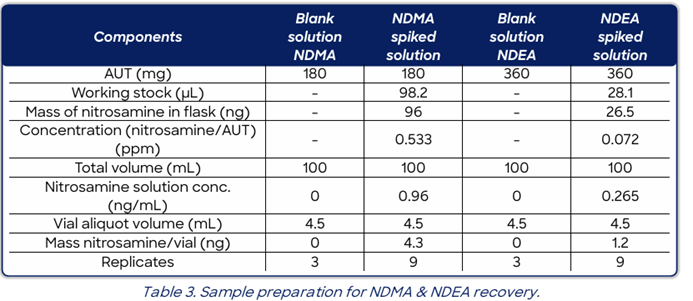
The Article Under Test (AUT) in this study was a finished drug product containing fexofenadine hydrochloride (MDD – 180 mg), a common antihistamine sold under the brand name Telfast®. Blank and nitrosamine (NDMA and NDEA) spiked solutions were prepared**.**
Effective headspace partitioning was achieved here by using a saturated potassium carbonate (K2CO3) solution for the preparation of the measurement samples. Samples were incubated at 80 °C for 15 min. in an agitator.
3. Instrument Conditions
Headspace was sampled using a 2.5-mL headspace syringe (heated to 120 °C) and subsequently injected at a flow rate of 23 µL/s into the Syft Tracer’s high-throughput (HTP) inlet (heated to 120 °C). The total sample flow into the Syft Tracer is 420 µL/s, with a balance of make-up gas (ultra-high purity nitrogen) introduced directly to the inlet. The analysis time for each sample was 240 s and the reported concentrations are the mean of the values obtained during injection.
4. Analysis and Results
-
Data acquisition and processing was carried out using SyftAuditTracer which supports laboratories in achieving 21 CFR Part 11 compliance by ensuring full traceability through data acquisition and processing, plus comprehensive user management functionality.
-
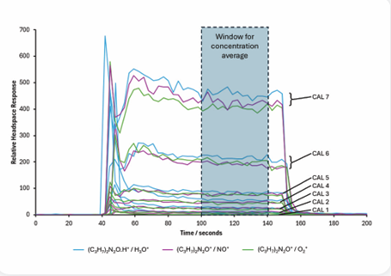
Representative Data - Headspace injection profile of Cal 1 to 7 of NDIPA displayed as analyte concentration per product ion. Notable features include an initial humidity spike at the time of needle penetration and a stable plateau from which concentration averages are taken.
5. Performance Characteristics
1. Repeatability - <8% RSD; n=12 for NDMA or 6 for remaining 5 nitrosamines.
-
Specificity - Despite the complexity of the test matrix the SIFT-MS method managed to selectively detect NDMA and NDEA at very low levels. Selectivity is aided by the utilization of multiple product ions, which arise from distinct reaction mechanisms, for quantitation. In cases where interference occurs at all product ions available, such as the 13C isotopologue of N,N-dimethylformamide which is known to interfere with NDMA, a simple subtraction can be performed
-
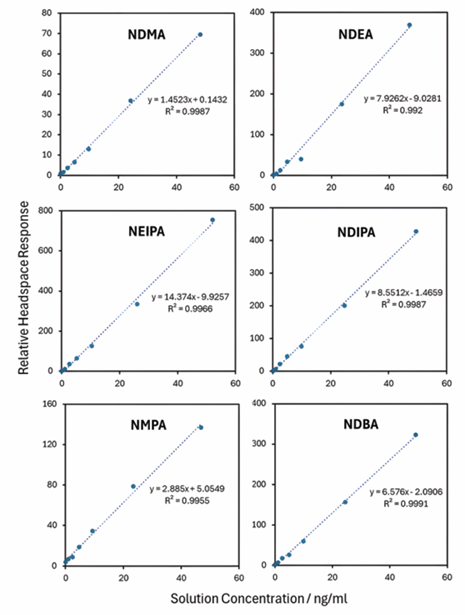
Linearity - All nitrosamines analyzed using SIFT-MS showed excellent linear response across the evaluated range (0 to 50 ng/mL). Calibration curves showing correlation coefficient (R²) for six nitrosamines analyzed using SIFT-MS shown below:
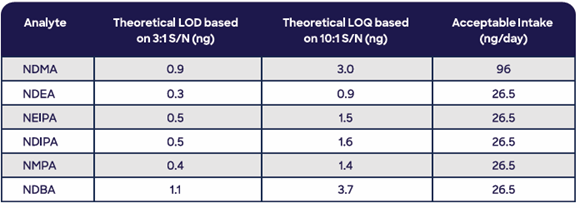
- LOQ/LOD - The signal-to-noise ratio was determined by calculating the ratio of mean concentration observed during sample injection (25 ng certified reference standard) to the mean post-injection background concentration. The limits of detection (LOD) and limits of quantitation (LOQ) of an analytical procedure can be estimated based on a signal-to-noise ratio of 3:1 and 10:1, respectively (according to the ICH Q2(R1) guidelines).
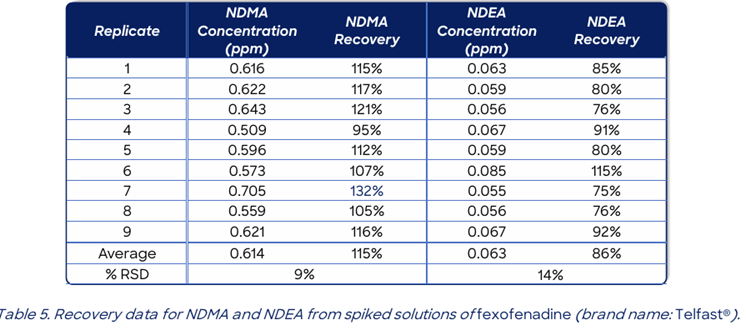
- Accuracy & Repeatability
Additional Notes/References
- The SIFT-MS method can detect NDMA with high specificity in the presence of known interferent compounds (DMF) in complicated matrices.
- Despite the complicated matrix of a finished drug product, SIFT-MS provided highly sensitive detection of NDMA and NDEA at low concentrations.
- A single configuration of the Tracer Pharm11 solution provides analytical flexibility to seamlessly switch between applications. This capability reduces instrument downtime, redefines analytical productivity and enhances throughput.
Thank you for contributing to the Nitrosamines Exchange!
By sharing your method, you help the community enhance scientific knowledge and practical approaches for nitrosamines analysis. If you have any questions or need clarifications, please reach out in the discussion thread below.
Disclaimer
This application note was developed to provide an analytical resource for regulators and industry to monitor nitrosamine impurities in drug products, drug substances or other matrices. It is intended to serve as a resource for informational purposes only and not as an USP-NF compendial documentary standard. This document was developed by USP staff without a public comment period and does not reflect USP or USP’s Expert Body opinions on future revisions to official text of the USP-NF. Parties relying on the information in this document bear independent responsibility for awareness of, and compliance with, any applicable federal, state, or local laws and requirements.
This is USP’s first non-compendial method published in Analytical hub for determination of Nitrite and Nitrate in Lactose. We will be posting more such methods for several at-risk excipients. This method can be used to establish level of nitrites/ nitrates in excipients and study lot to lot variability. It is intended to serve as a resource for informational purposes only and not as an USP-NF compendial documentary standard. Users will have to verify suitability of this procedure for intended purpose