Date: April 22 - 23, 2026
Day1: Wed, Apr 22 9:00 a.m. - 05:25 p.m. ET
Day2: Thu, Apr 23 9:00 a.m. - 05:00 p.m. ET
Location: Attend In Person or Online
Virtual: Via Adobe Connect
In Person: FDA White Oak Campus
10903 New Hampshire Ave, Building 31
The Great Room
Silver Spring, MD 20903
United States
About this Event (Hosted by CDER SBIA)
The annual Generic Drugs Forum is a two-day event designed to facilitate the development and approval of safe, effective, and high-quality generic medicines. This premier event brings together FDA subject matter experts from every aspect of the pre-ANDA and ANDA assessment programs, offering unparalleled insights and guidance.
Attendees will gain practical regulatory knowledge to enhance their applications, streamline the assessment process, and reduce cycles. The forum’s primary goal is to support prospective and current applicants in submitting complete and high-quality submissions, ultimately ensuring timely access to affordable medications that benefit public health.
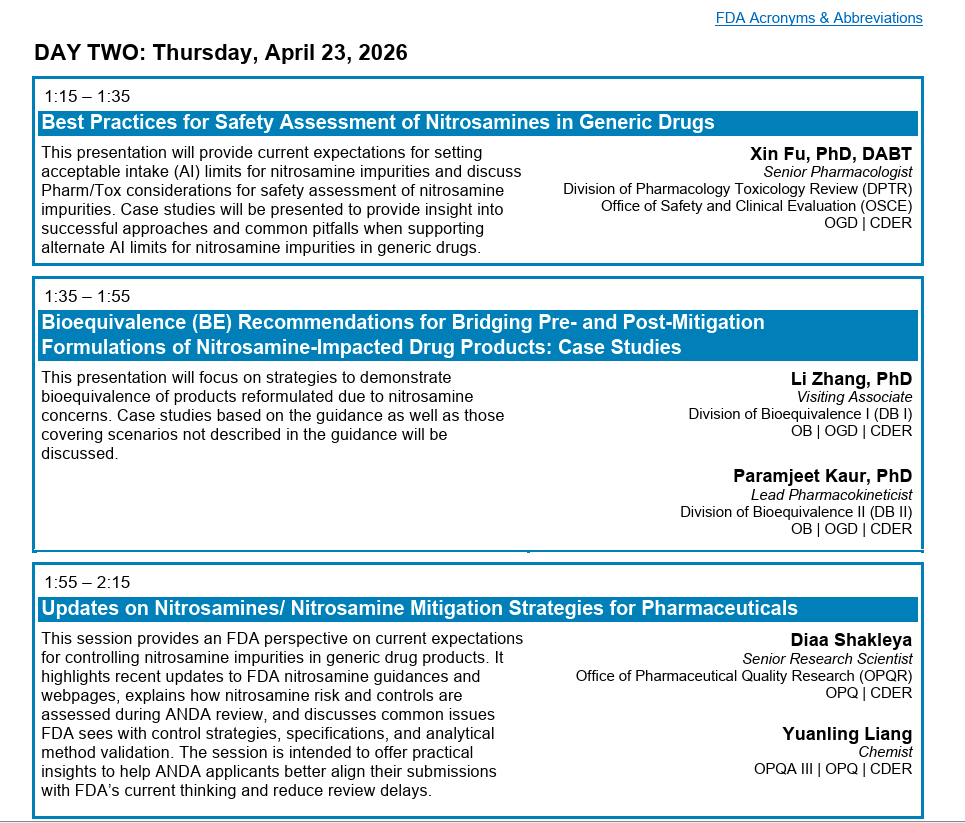
Bioequivalence (BE) Recommendations for Bridging Pre- and Post-Mitigation Formulations of Nitrosamine-Impacted Drug Products: Case Studies D2S11-Kaur+Guo-v1.2-FINAL.pdf (413.0 KB)
Best Practices for Safety Assessment of Nitrosamines in Generic Drugs D2S10-Fu-v1.2-FINAL.pdf (302.1 KB)
In case you missed it… Below are the questions asked to the FDA panel
Handling Unavailable NDSRI Physical Standards Question: What data is expected if the physical standard for an NDSRI (Nitrosamine Drug Substance-Related Impurity) is not available or cannot be synthesized due to chemical instability? FDA Answer: If it truly cannot be manufactured, the applicant must provide stress studies (using various aqueous and organic conditions) proving that the molecule cannot be formed. If it can form but the standard cannot be made, the applicant will need to make scientific assumptions about relative response factors.
Expanding the CPCA Framework Question: Is the FDA planning to expand the Carcinogenic Potency Categorization Approach (CPCA) to include more functional groups (like esters and sulfonyls)? FDA Answer: While the specific experts were not on the panel, the FDA confirmed they are continuously working to further refine the CPCA framework based on new information.
Supplement Filing Categories for Unlisted NDSRIs Question: What is the correct filing category for NDSRIs that are not currently on the FDA’s published list, especially when they don’t exceed 10% of the CPCA limit? FDA Answer: If the NDSRI is not on the list, 26.5 ng/day is the conservative baseline. If confirmatory data shows the limit is less than 10% of 26.5 ng/day, it is an annual reportable change. If you propose a limit greater than 26.5 ng/day using the CPCA calculation, it requires a Prior Approval Supplement (PAS) because it necessitates a PharmTox review.
Ames Test Results and Public Communication Question: If a nitrosamine tests negative in the Enhanced Ames Test (EAT), what is the control limit? If it tests positive, does the FDA communicate that mutagenic risk externally? FDA Answer: If a nitrosamine tests negative (and lacks compound-specific data), the control limit defaults to the CPCA-based Acceptable Intake (AI) limit. If it tests positive, it is considered mutagenic and also defaults to the CPCA-based AI limit. Regarding communication, if a positive risk is identified by the National Center for Toxicological Research (NCTR), the FDA may refer to that published citation or communicate the risk directly to applicants on an application-specific basis.
Selecting Specific Antioxidants for Mitigation Question: Are there specific antioxidants (like Vitamin C or E) that the FDA recommends or that work better than others for mitigating nitrosamine formation? FDA Answer: Antioxidants are “fit for purpose.” Different antioxidants work differently depending on the formulation and must be tested throughout the product’s life cycle. Applicants need to perform method development and test specific antioxidants with their unique drug product.
Status of August 1st NDSRI Progress Reports Question: Is there a progress update on the NDSRI progress reports that were due on August 1st, and when can industry anticipate feedback? FDA Answer: The FDA is currently reviewing and compiling all the information from the submitted progress reports. There is no specific date yet for a public announcement regarding the next steps.
New BE Studies When Changing API Sources Question: In the presented case study, why was a completely new Bioequivalence (BE) study required when changing the API source, given that nitrosamines are a toxicological safety issue rather than a pharmacokinetic one? FDA Answer: The new BE study was required because the original API facility had unresolved CGMP (Current Good Manufacturing Practice) violations. Consequently, the quality of the original bio-batches could not be assured. If there were no CGMP issues, comparative dissolution data alone would generally suffice when changing the API source.
Strength-Based Nitrosamine Specifications Question: Can applicants use strength-based nitrosamine specifications (allowing higher limits for lower strengths) instead of applying a single specification across all product strengths based on the Maximum Daily Dose (MDD)? FDA Answer: Generally, the specification applies to the API, so the nitrosamine limit should be the same across all strengths because the MDD is consistent. However, for products with a very wide range of MDDs for different strengths, the FDA may permit different dose-specific limits. The FDA recommends submitting a Control Correspondence to address this on a case-by-case basis.
Q1 - Handling Unavailable NDSRI Physical Standards If it truly cannot be manufactured, the applicant must provide stress studies (using various aqueous and organic conditions) proving that the molecule cannot be formed.
FDA expect/suggest to perform forced degradation studies to support for the Unavailable NDSRI Physical Standards claim. But this is required to perform for finished product also.
Indeed a good clarifying question yesterday…
What I take from it was: A general knowledge that the impurity does not form, is NOT enough. Evidence must be presented to the agency to justify the absence of the impurity. Most likely, it’s not enough to just buy and hand out the ‘non-Synthesizable’ reports for these impurities.
I was there during the second day, especially because my baby, the DMF Division was involved in session and of course the nitrosamines. While the DMF team did a wonderful session, though very high level, the nitrosamine session was a bit of disappointment. To start, several clients had asked me to pose a few questions and we all thought that being there in person would help in getting better response from the FDA. WRONG!!! The Agency avoided uncomfortable questions on nitrosamines that I was asking. Nobody could respond if CPCA which is highly inadequate covering only 3-5 organic functional groups will be expanded to cover other functional groups. My question was based on the fact that they were claiming that they also do scienctific studies on nitrosamines. My focus was on ether groups, sufonic acids etc. But I was told that this was beyond their level even though the deputy director of the division was sitting right there and could have given some response. I was expecting some meaningful exchanges like why Less than lifetime approach is not being accepted by FDA when the entire world is ready to do so. We know that ICH M7 group is discussing this but it would have been good to hear from FDA’s mouth why they are resisting this. But as soon as I said, “LTL”, I was told that I should give others a chance. There was only one other person standing there and he later said, he would have been happier if he heard anything about LTL. Another question that I had planned to ask was why sponsors are being asked to control nitrosamines at 1500 ng/day even when all the in vitro tests are negative and transgenic mice assay: what can a sponsor do to justify limits at ICH Q3A/B. But what they did was start taking quesitons from online, and that too, very basic questions, like, “How do I know if a nitrosamine is mutagenic?” - read articles, do an EAT if your are in doubt. The worst part about this was the attitude of the SBIA staff, some of whom didn’t think that when someone spends the resources, time and effort to come to a conference, they should be given some respect. Also, either they are directed to ask easy questions or they just do not know what constitutes a meaningful question. The questions that were asked to the forum were from online were simplistic, while I know many posted very important questions in line with what I was asking. The slides are informative though and I am sure Yusuke Mino San will be posting them.
I thought that may have been a proper response. If a drug goes from 2 mg to 500 mg, we may need two sets of limits considering the fact that 2-10 mg are possibly given to a pediatric population.
This is a big problem. I have clients who did the studies to show that the nitrosamine is not formed but were asked to do more experiments. The issue is that there may be other sponsors who claim that they can make it. Nitrosamine NMR are not trivial. Even in the late 90s, people could get a PhD working on nitrosamine NMRs of complex products due to the shielding and deshielding of the -N=O group. I feel even with relatively simpler products, the FDA is being challenged related to interpretation of the NMRs. The topic of ticagrelor came up. Nitrosation of ticagrelor usually leads to the formation of an isoxazole. But FDA put a hypothetical structure in their website that confused everyone. Now I do see that some companies claim to have made the nitroso-ticagrelor. And based on their own documents, it took a lot of effort and careful consideration. Now we have lost sight of the practical aspects of life. Are we intentionally trying to make N-nitroso ticagrelor or are we looking to see if it could be formed during synthesis of API, manufacturing and shelf life of the product. The response is possibly, “No”. Our wish is that FDA stops being pedantic and keeps an eye of the practical aspects of nitrosamines.
In the last topic , I have a question : But for a combination, should I base it on the limiting dose, correct? For example, Metformin + Dapagliflozin, the limiting dose is Dapagliflozin at 10 mg daily. In a combination of 10 mg + 500 mg (metformin), should I keep the calculation at 500 mg or overestimate the 2,000 mg daily?
Treatment of DR Products Under Nitrosamine Guidance Question: The nitrosamine guidance recommends the alternative approach only for IR products. In the case study, a delayed‑release capsule was treated like an IR product.
Does this mean FDA generally treats DR products as IR products? FDA Answer: No. This was a unique case. Only the IR portion had a formulation change, so it was handled like an IR product. If the delayed‑release layer had any manufacturing changes, FDA would require additional data. Assessment is case by case, not a general rule.