I am currently working on a product containing nortriptyline, and we had developed/validated a quantification method for N-nitroso-nortriptyline (NNNT).
I would greatly appreciate your input on the following topics:
1. Contribution of the analytical method to nitrosamine formation
How to assess whether the quantification method itself may promote in situ NNNT formation during sample preparation or analysis
Practical strategies to mitigate or eliminate this risk (e.g., control of pH, temperature, nitrite sources, use of scavengers, etc.)
2. Approaches to justify NNNT increase over time
Scientific and regulatory approaches to support that NNNT levels may inherently increase over time in the product
How to demonstrate that this increase may not be fully controllable despite appropriate formulation and manufacturing controls
Strategies to justify and set a stability limit/specification that appropriately reflects this behavior
Your experience and perspective on these points would be extremely valuable for our assessment and development strategy.
To assess whether the sample prep etc. is causing the formation of the nitrosamine and leading to “false” high nitrosamine results then the method that I have seen employed is to add a scavenger into your sample prep and run it versus the same sample prepared without the scavenger. Ascorbic acid is the easiest to use in terms of availability etc. It is generally accepted that if there is no difference in the results then there is no formation in the sample prep. If the sample without the scavenger is higher then this suggests that there is some formation in the sample prep. One watch out with this is that certain scavengers have been observed to actually accelerate the formation of certain nitrosamines, and so it is theoretically possible that you may see an elevated level in the sample containing the scavenger. This then becomes the case of finding an appropriate scavenger for your molecule/sample prep that doesn’t cause the additional formation.
I would agree that you have to assess the introduction of ascorbic at first place. However make sure to test sample’s stability/recovery as well to ensure no further degradation/loss due to ascorbic that may result in false negative results.
kindly
I definitely agree with Mark & Eleni. I’ve particularly seen Lys & His, which have been labelled as inhibitors in at least one publication of my memory, catalyze nitrosation. While I have not seen or heard of the false negatives Eleni mentions, the ramifications are huge. You must prove that.
In the past, we’ve normally used 1% ascorbic acid in our preparations until we prove it is not needed through the solution stability Mark mentioned. We would always perform a spike recovery to gauge method performance until validation. That can answer the issue Eleni mentioned.
I would also recommend checking different pH values for your sample solution. We observed that some analytes competed with the scavenger, resulting in nitrosamine formation. The desired scavenging effect was only achieved after adjusting the pH.
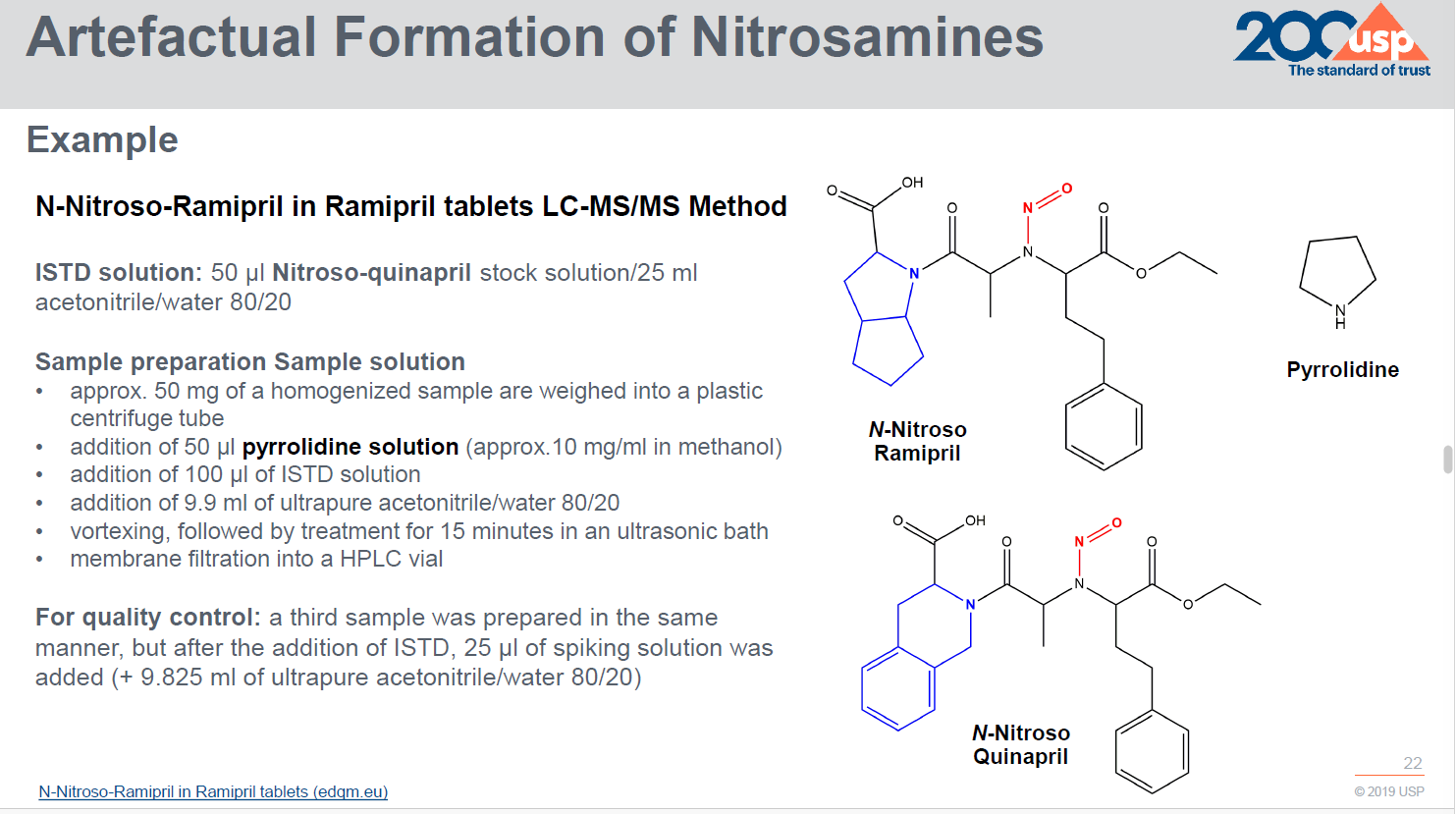
@Naiffer_Host presented an example of the N-nitroso ramipril assay at the FDA-CRCG Joint Workshop in 2024. In this assay, pyrrolidine was used as a quenching agent for nitrite.