Hello,
I have a situation regarding the N-Nitroso Desmethyl Tramadol. The EMA appendix describe this nitrosamine as “N-[[(1R,2R)-2-hydroxy-2-(3-methoxyphenyl)cyclohexyl]methyl]-N-methylnitrous amide”, so from this point of you I consider that only the R,R enantiomer should be analysed.
However most suppliers have the standard for N-Nitroso Desmethyl Tramadol as an enantiomer sum (and the purity for only R,R can not be calculated). Does anyone had this problem? Is really only the R,R enantiomer be considered? I already ask EMA this situation, but with no luck at the moment.
Best Regards,
Daniel Silveira
1 Like
Daniel,
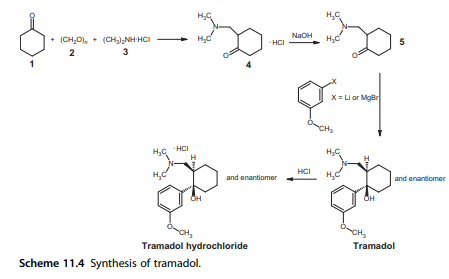
I think it’s worth starting with the API manufacturer’s synthesis route. It provides useful context for the stereochemistry involved and may help guide the analytical strategy. As an example, consider the synthesis described in this reference: Profiles of Drug Substances, Excipients and Related Methodology, chapter 11:
As you can see, the synthesis starts with a Mannich reaction, followed by addition of the Grignard reagent to the resulting ketone. At the end of the scheme, both the “Tramadol” and “Tramadol hydrochloride” structures are shown with an “and enantiomer” note next to them. The same chapter further states that the product of this route is the racemic cis pair (1R,2R + 1S,2S).
Also, the compendial impurity table (same chapter) already lists O-desmethyltramadol (a metabolite/impurity structurally analogous to the nitrosamine we’re discussing) with the racemic descriptor (1RS,2RS) and the same “and enantiomer” note, rather than being restricted to a single isomer.
As for the logic EMA applied when naming the appendix, there might be some additional rationale I’m just not seeing (I may be overlooking…). If you happen to receive a response from them, please share it here, I’d genuinely like to know.
But based on this synthesis route and how the pharmacopeia already treats structurally related tramadol compounds, quantifying the nitrosamine as the sum of enantiomers seems more consistent with the chemical reality of the material than with a limitation of the commercially available reference standards.
Best regards, Lucas
4 Likes
Hello,
I just got the answer from EMA regarding the Nitroso-Tramadol. I leave it below.
“The CPCA categorisation underlying the acceptable intake for N-nitroso-desmethyl-tramadol does not consider chirality. The stereochemical designation in the name of the compound should therefore not be interpreted as limiting the scope of the acceptable intake to the (1R,2R) enantiomer only.
Accordingly, all enantiomers may be controlled collectively, and there is no expectation to specifically quantify only the (1R,2R) enantiomer. Analytical methods and reference standards that do not distinguish between enantiomers can therefore be used for the control of N-nitroso-desmethyl-tramadol.”
5 Likes
Thank you for sharing EMA’s response, @daniel.silveira.
This clarification also aligns with the chemical rationale discussed earlier. Since tramadol-related materials are typically handled as racemic mixtures and commercially available reference standards are supplied as the sum of enantiomers, controlling all enantiomers collectively is scientifically justified and, as EMA has now clarified, fully acceptable from a regulatory perspective.
I’m sure this clarification will be helpful for other laboratories facing the same question.
3 Likes