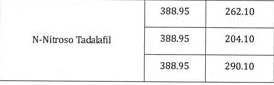
I am developing an LC–MS/MS method for N-nitroso tadalafil. Based on structure, I expected the [M+H]⁺ precursor around m/z 419, but in my scan I am seeing a strong signal at m/z 389.
Has anyone else observed m/z 389 for N-nitroso tadalafil?
Is this a valid precursor ion or could it be an in-source fragment/adduct?
Any insights or shared experience would be very helpful.
if I may intervene, I see that community’s attention and interest is increasing in relation to Nitroso-compound. I am wondering if this comes from regulatories’ requests…
The ion 389 that you are working is the nitroso-tadalafil molecule without the nitroso (NO) group. We had the same issue and after some testing (Scans, etc.) and discussions with the standard supplier we were able to find the the compound is unstable in the LC-MS/MS source (probably due the temperature, as we find out later in the method development) and could not find the ion 419 with enough intensity to work with. So we use also the 389.
However, if you work with 389 you must be able to separate the nitroso-tadalafil from tadalafil with enough resolution, as tadalafil as the ion 390 as [M+H]⁺ and can interfere with the 389 ion (with neutral form 389 or isotopic profiles).
Hi everyone, here is a link where you can find more strategies on how to mitigate in-source fragmentation in NDSRI analysis using LC-MS. I believe this resource will be valuable to the community:
Could you share how to separate N-nitroso tadalafil from tadalafil? We are also using the 389 ion, but tadalafil’s interference is too significant. Anyway, thanks very much.
The separation had enough resolution between the tadalafil API and Nitroso-Tadalafil to ensure the analysis. We use as mobile phase of water (A) and acetonitrile (B), with minimum additive concentration (formic acid) to prevent the degradation of nitroso-tadalafil during elution. We use a F5 column, but I think that a C18 can do the work too. We tried several gradients and found a compromise between sensibility and elution with 50:50 H2O and ACN.
The sample concentration was not to high to ensure that the API peak was not to intense (to not interfering with Nitroso-Tadalafil) (around 0.3 mg/mL of API).
For mobile phase A, we use H2O with 0.1% of formic acid and for mobile phase B we use ACN without additive. I think the method could work without additives if you need to. The additive was added due to the determination of another nitrosamine (together with nitroso-tadalafil).
Hi Daniel! Found the other discussion, thanks for the prompt response. Do you have any idea on the stability of this nitroso compound with your preparation?
Hello, we studied until approximately 72 hours and it was stable at low temperatures. Just for you to know we studied the stock solution at -18ºC (we had to guarantee that no degradation happened) and the standard solutions at -18ºC and 5ºC. It helped a little ask to the supplier some information of the stability. Some suppliers have.
Hi Daniel, thanks for the information. I asked the supplier but have no answer yet. I tested the cooled preparation and indeed finally got some results. I lowered source fragmentor voltage and temperatures as well and actually got the M+H from the nitrosamine as a confirmatory test! My assumption is that the 72 hours is app. 80% recovery and at 5 degrees C?
You can assume that, yes. When we developed the method we keep always the same solutions also at -20ºC just to be sure. Regarding the MS parameters, because we had to quantified the Nitroso-Tamsulosin, the had to comprise between the tow nitrosamines (Nitroso-Tadalafil + Nitroso-Tamsulosin).
Regarding our part as laboratory, we had performed a set of confirmatory testing for some dosages of Tadalafil drug product and that was sufficient to our client, as far as we know.
As I said, the method had some particularities (standard, extraction, etc.) but at the end of the day, we were able to finish the project.
Out of curiosity, may I ask how did you manage the stability of solutions while actually injecting and during the chromatographic run, etc.?
It is known that N-nitrosated indoles are very unstable and makes sense for them to be under freezing conditions, which makes you think, what is the actual probability of formation of the compounds in real pharmaceutical operations.
The stability of solutions were short and just enough to get through sample preparation and injection during our confirmatory testing sequence.
The autosampler was at the lowest temperature possible and the mobile phase did not have a high concentration of additives. The samples were at a very low temperature (as a very low temperature was part of our extraction process) before injection.
Regarding the formation of these compounds in real pharmaceutical operations, from what I understand with our standard supplier is that the Nitroso-Tadalafil was stable at solid state.