In the process of making submission to add nitrosamine limits on release and at end of shelf life. Have set these limits on the specification in terms of ng/day. All of the development and testing has been done in terms of ng/day - to meet the limits from the EMA for the particular nitrosamine, which are expressed in… ng/day.
An authority has come back and asked for all of the limits and data to be expressed in ppm instead. Has anybody else experienced this? Did you go back to the authority to argue for the use of ng/day.
PPM just seems such an odd unit to use, as it could/would be different for different products with the same API, depending on dose etc.
The ng/day units has already been accepted by some other markets - don’t want different specification limits in different markets solely due to the units being used.
Any advice from experience of this would be much appreciated.
I have only put them in ppm with respect to API. This then keeps it the same from product to product with the same API. This has been widely accepted. I know many of my clients have done the same. I have not heard of regulatory acceptance for ng/day. I’m sure it’s happened, but I haven’t seen it.
This is also in keeping with calculations you see in the FDA guidance, etc.
In contrast, in one of our cases, we have been asked to express all results in ng/day instead of ppb. So this is also a “gap” or “grey zone” (i dont know what to call better) between the Authorities.
However, if we are talking for EU, also EMA Q&A recommends that “Specifications for individual N-nitrosamines should generally include an AI limit expressed in ppm or ppb”. Also CMDh step 2 for confirmatory test outcome is given in “ppm”. So I was a bit surprised.
In any case, what if you expressed results in both ways. That should be also acceptable by your HAs.
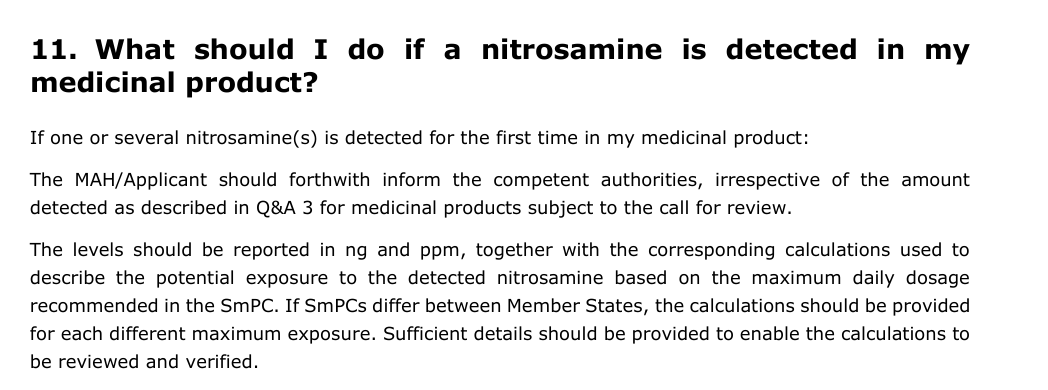
Hi all. It depends, when notifying to authorities the results of confirmatory testing, the requirement is to notify both in ng/day and ppm (see screenshot from the Q&A)
But, if we are talking about setting a specification, it has to be done in ppm (or ppb, if the specification is low enough)
Thank you both for adding these notes, @elenipoliti & @JavierFernandez. I was sure it would be the case that some would require ng/day.
This is probably what you’re saying, to Javier; I always took this statement from EMA to refer to the initial correspondence and justification of specifications, not the specification itself.
I’m not sure I can add much after all the great input, but I would note that we usually express impurity limits in both ways because they are related, although they represent different concepts.
ng/day represents the amount of an impurity that a patient may ingest daily, while ppm (parts per million) is a unit of concentration and is therefore more appropriate for expressing the amount of impurity present in a material (API or drug product).
In summary, the Acceptable Intake (AI) is established in ng/day, whereas the analytical specification is typically expressed in ppm after conversion using the Maximum Daily Dose (MDD).
I fully agree with Javier and João: nitrosamine concentrations should be reported in both units, as stated in the EMA Q&A, because they represent different concepts and serve different purposes.
That said, I would like to raise a broader question: when will we move away from potentially ambiguous units such as ppm? I have seen numerous errors arising from whether ppm is expressed relative to the finished product, the salt form, the anhydrous free base, or—more challenging still—a formulation containing more than one API.
There is also the issue of comparability between low-molecular-weight nitrosamines and NDSRIs, which can have molecular weights up to approximately ten times higher. The same concentration expressed in ng, or ppm, may therefore correspond to approximately ten times fewer molecules for a higher-molecular-weight NDSRI.
Surprisingly, neither the nitrosamine guidance nor other relevant guidelines appears to address the more scientifically consistent and directly comparable approach of expressing molecular concentration, for example in nmol/mL or nmol/day.
Using ng/day units would also require specifying the daily dose for the information to be complete.
Impurity limits are more commonly expressed as concentration values. Even when different dosage strengths contain the same active ingredient, separate specifications would typically still be required, so I do not see a significant drawback to this approach. Alternatively, the result could be reported at the API level, as @jason.brown mentioned, in which case the same limit could potentially apply across all dosage strengths.
Ultimately, the most important consideration is that the reporting approach and acceptance criteria are clearly defined to avoid ambiguity, questions, or misunderstandings.
@Ganza Wether it would be more logical to consider the molecular weight of the nitrosamines is an older debate, see for example Redirecting and many discussions in this group.
Thanks for sharing and your valuable insights @mflorea. To err on the side of caution, we have recently reported nitrosamines for a topical formulation in ppm relative to the API, ng/g of ointment, and finally ng/day and % of the AI taking into account the maximum daily dose. Hope this would be clear enough for the regulatory agency!