We are observing an interesting phenomenon in certain amine-containing substances during storage and formulation, and we are looking for mechanistic insights or similar experiences from the community.
Observations:
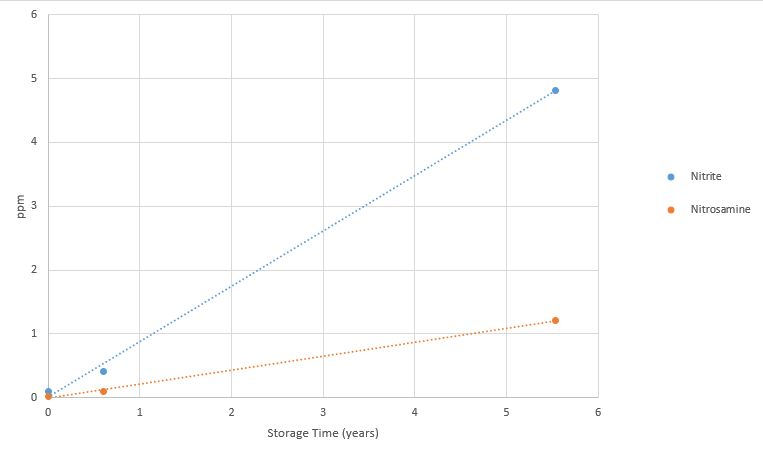
1. In a highly pure secondary amine , we measure increasing nitrite and nitrosamine values over time. Nitrite was measured with two orthogonal methods.
2. The ratio of nitrosamine to nitrite is remarkably constant across multiple time points and storage conditions.
3. In some APIs, we also detect nitrite traces even when nitrite was not intentionally used. Calculated purge factors cannot fully explain the measured levels, when nitrite is used during synthesis.
Questions / discussion points:
Do these observations support the hypothesis of a “common reactive precursor” (possibly a NOx-derived or otherwise bound species) giving rise to both nitrite and nitrosamine?
* Are there known mechanisms in low-moisture / non-aqueous systems that could explain this, including possible radical-mediated pathways in addition to classical nitrosation?
* Could similar dynamics explain trace nitrite formation in solid API, independent of intentional nitrite addition?
We welcome any insights, references, or experiences you could share. Our goal is to understand the mechanistic underpinnings without attributing root cause to a specific product or supplier.
As you may know, Dr. Grahek from Sandoz said that leaving an excipient exposed to the atmosphere led to an increase in nitrite levels(link). Based on the same principle, I believe it is quite possible that nitrite levels in an API could also increase simply by being exposed to air. An increase in nitrite levels within the API can lead to the formation of nitrosamines. There are also known cases where NDSRIs increased during the API milling process or storage.
Therefore, even when nitrite is not intentionally added, I believe that nitrosamines can still form within the API.
I am hearing more and more concerns about this from several manufacturers. They have had to revisit their risk assessment after observing a shift in nitrite content.
Marko @TrMa1990 do you have any update on this issue?
We measured several amines and discovered a clear pattern:
the molar ratio between nitrite and the corresponding nitrosamine was remarkably constant.
This strongly suggests that a common source is responsible. Under our specific conditions, the formation of nitrite appears to be the more favourable pathway, whereas nitrosamine formation is slower but still correlated.
All amine samples were highly pure and stored in tightly closed brown glass bottles.
From this we can derive two problems:
If the amine is already old (but still within shelf‑life), we observe an initially elevated nitrosamine level.
During stability testing, the existing nitrite in amine can slowly react and form additional nitrosamine over time in the product, where the conditions (pH, water content, etc.) are different than in the pure amine. In our case conversion rate of the nitrite is fortunately quite low, but the high levels found of nitrite (around 3-6ppm at end of shelf life) are quite concerning.
We also performed experiments where we stirred the amines under exposure to air, and the measured nitrosamine and nitrite levels increased as well. This clearly points to something in the air being responsible.
I came across a publication (Redirecting) suggesting that H‑abstraction from the amine by reactive nitrogen species may occur, which could explain the formation pattern we observe.
The alternative explanation would be a reaction with residual water in the amine forming nitrite.
Understanding what is really happening will help us maybe to prevent such issues in the future.
very interesting discussion, thanks Phil for this!!
let me ask if you have ‘‘locked’’ (and ‘‘blocked’’) the case to generate nitrites by your own during the sample preparation (e.g. by using ultrasonic).
And one more question, have you measured the NOx content in the atmosphere of your lab or plan?
From our side, we do not measure the nitrites in the APIs we used for the formulation but in general, the levels of nitrosamines in the APIs are remaining stable during the time. We have not notice any significant increase even for secondary amines APIs.
Just to note that our plan is located in a non-urban area
Yes, we measured it with two different methods. (HPLC-FLD 2,3-Dan and IC with Gries)
Values from both methods match.
We use only a slow shaking process and using nitrogen to displace oxygen.
We discovered that ultrasonic bath and vortexing generated nitrite during sample preparation. After flushing the oxygen out (therefore reducing the risk of sonochemical oxidation), we measured no increase. Nethertheless we only shake the samples very slowly and carefully to reduce the risk of formation.
I did raise this, but currently we do not measure this. We have an station provided by the state which is fortunately not that far away from our site. So we only have a little bit of data.
I expected to find nitrite everywhere, but i did not expect to see an increase during shelf life.
I know it´s only three points so far but similar trends were also discovered for other amines.
Last point is out of shelf life, but as you can see increase does not stop.
We will set up a more detailed study in the future, but i think that´s quite concerning.
With this depending on the age of the amine we get an high nitrosamine value and during stability the remaining nitrite then forms even more nitrosamine. So basicly a double edged sword.
Thanks @Phil for the fantastic insight… I am adding this discussion to our feature topics in the community. Thanks everyone in the post for sharing their experience.
Have any of you had similar findings on your sample preparation as Phil reported here?
Interesting! Are you using any special excipients containing an NO2/Nitrate Ester groups etc ..Some possibility for the formation of nitrites when these excipients under go reaction/degradation.This is just my two cents thought.
Hello everyone. During our screening for nitrite content in excipients, we have also observed increases in nitrite and nitrosamine levels over time. In some cases, even within short periods, significant discrepancies were seen in test results for the same batch of excipients. Through comparative analysis, we determined that ambient humidity can affect test outcomes to a certain extent, including during sample pretreatment and weighing procedures. For highly hygroscopic excipients, particular attention should be paid to controlling both temperature and humidity in the testing environment.
Yes, I have repeatedly raised here the topic of API polymorphism and their piezoelectric properties. Examples I have encountered directly include hydrochlorothiazide and sitagliptin.
In the case of hydrochlorothiazide, nitrosamine impurity formation was driven by friction between crystals in an air atmosphere, with concurrent generation of nitrogen oxides at the crystal surface; a range of mitigation strategies has been proposed via modification of crystal surface properties (EP4234542A1).
In contrast, for sitagliptin, the phenomenon was associated with a polymorphic transition, also dependent on the surrounding atmosphere in which it occurred, again pointing to the potential role of in situ NOx generation at the solid state interface. Importantly, the hydrochloride form is particularly sensitive to solid state transformations, and uncontrolled rehydration of the anhydrous form can create local moisture gradients and energetic instability, promoting nitrosamine formation. In this case, the impurity (NTTP) was observed to form directly from the amide, rather than exclusively via prior hydrolysis to a free amine.
To address this, we have proposed a controlled rehydration approach (EP4469459B1), where the conversion from the anhydrous form to the monohydrate is carried out under defined RH, time, and atmosphere, preferably using humidified inert gas. This enables gradual, diffusion driven incorporation of water into the crystal lattice and allows equilibration of the energy state and crystal structure, minimizing surface reactivity and reducing the risk of in situ NOx formation and subsequent nitrosation.
1 . for sure the use of ultrasonics is banned-there are many publications already highlighting the formation of nitrite during the ultrasonic process. We have studied this a little and the results depend on the solvent used and not always in the more obvious was.
Following on the earlier work with Rok we have noticed that certain excipients have a high affinity for NOx whereas others don’t. This is in the process of preparation and, obviously has significance both on analytical work but even more so on methods of manufacture where large volumes of air are in involved (wet granulation or spray drying). In the presence of certain excipients NOx may have little impact but in the case of some they concentrate and retain the NOx releasing it slowly to cause nitrosation over a period of time.
Hi Phil.. i just saw your post on nitrite in amines.. you said that we found vortexing and sonication increases nitrite.. that’s amazing to hear.. can you share you data you generated using vortex and sonication. Do you have any article which backs the genration of nitrite through vortexing…?? Or can you explain how vortexing generates nitrite?? It will be helpful for us in method development of nitrosamines.. thank you in advance