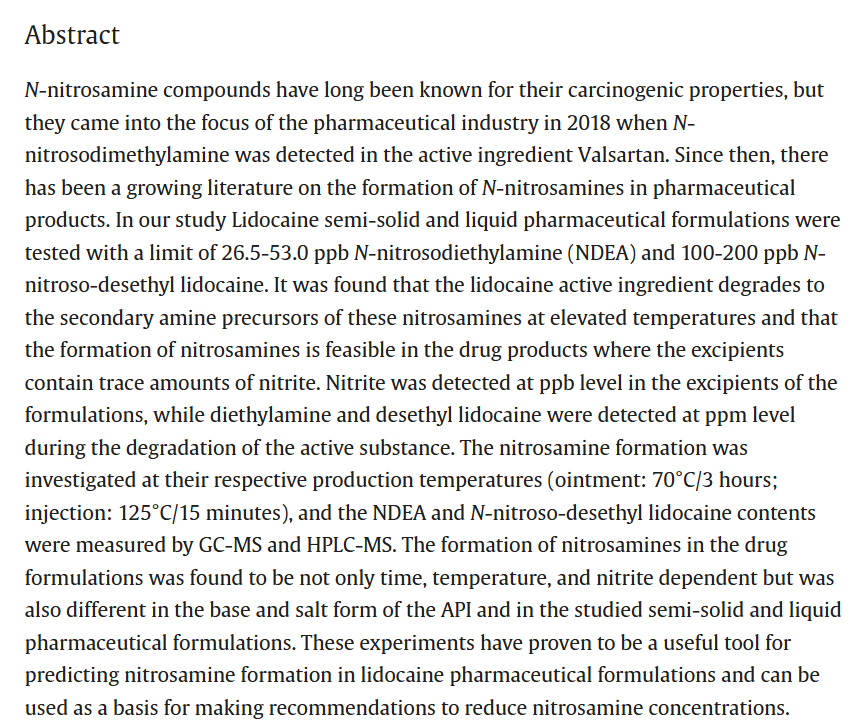
first paper that I have seen that is specifically targeting investigation into topical and intravenous routes of administration
the difference in behaviour between the base and the hydrochloride at different pH levels
the formation of the NDEA or the desethyl nitrosamine
a different proposed route for the formation of DEA to lead to the formation of NDEA
different levels of DEA present in the drug substance based upon whether the temperature is above or below the melting point of the base.
It shows the level of formation of NDEA and/or the desethyl nitrosamine when the products are spiked with different levels of nitrite, but I feel that there is one gap - it doesn’t report he levels observed in unspiked samples that I can see anywhere - commercially sensitive?
Great finding @MarkS … Unique in their experimental approach to study the formation. I believe its a great example for the team trying to investigate their semisolid formulations. Eye opening their temperature considerations becase the manufacturing temperature.
I also want to highlight the information in the supplemental section. The analytical method used has been included in the publication.
Method M-1.: Determination of diethylamine in lidocaine and lidocaine hydrochloride monohydrate active pharmaceutical ingredient
Table S1: Analytical performance characteristics of method M-1
Parameters
Results
Range
9-1080 ppm
Linearity (R) [-]
1.000
RSD% reference sol. [%]
2.8
Accuracy limit level [%]
82.5 – 91.4
LOD (S/N=3)
3 ppm
LOQ (S/N=10)
9 ppm
Method M-2.: Determination of desethyl lidocaine in lidocaine and lidocaine hydrochloride monohydrate active pharmaceutical ingredient
Table S2.: Analytical performance characteristics of method M-2
Parameters
Results
RSD% reference sol. [%]
6.5
Accuracy limit level [%]
89.2 – 97.1
LOD (S/N=3)
10 ppm
LOQ (S/N=10)
30 ppm
Method M-3.: Determination of N-nitrosodiethylamine in lidocaine and lidocaine hydrochloride monohydrate drug products by GC-MS
Table S3.1.:Analytical performance characteristics of method M-3 for the lidocaine ointment
Parameters
Results
Range
5.3 – 265 ppb
Linearity (R) [-]
1.000
RSD% reference sol. [%]
2.6
Accuracy limit level [%]
117.9 – 137.4
LOD (S/N=3)
5.3 ppb
LOQ (S/N=10)
17.7 ppb
Method M-4.: Determination of N-nitroso-desethyl lidocaine in the lidocaine injection by HPLC-MS
Table S4.: Analytical performance characteristics of method M-4