Nitrosamines: Mass Spectrometry-Based Analytical Procedures Criterias

Are you facing significant challenges in your analytical methodology for quantifying nitrosamines?

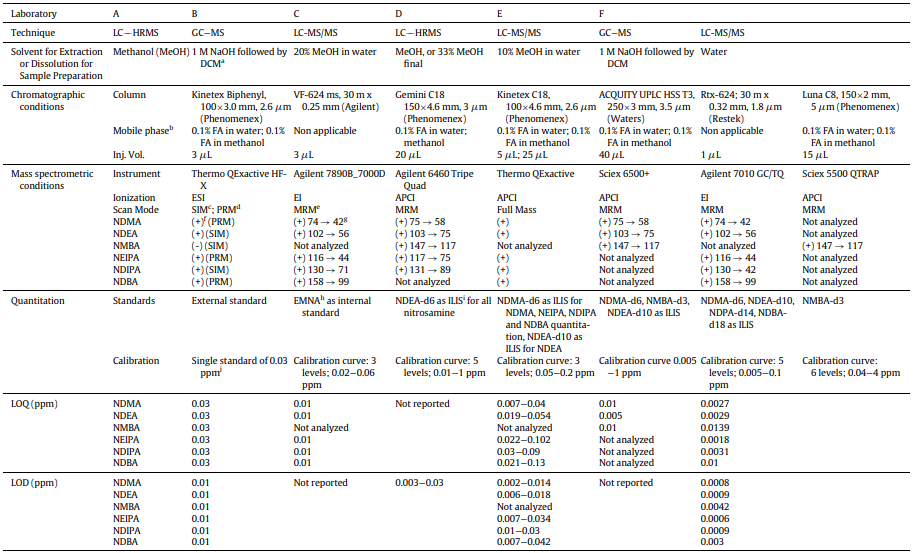
A collaborative effort involving various regulatory bodies occurred, including: US FDA, Health Canada, ANSM (France), Swissmedic (Switzerland), LGL (Germany), and TGA Laboratories (Australia). This partnership aimed to investigate the consistency of nitrosamine measurements. Each lab contributed its unique analytical methods to assess nitrosamine levels in standardized samples.

In the paper titled Performance Characteristics of Mass Spectrometry-Based Analytical Procedures for Quantitation of Nitrosamines in Pharmaceuticals: Insights from an Inter-laboratory Study the authors demonstrate their success in accurately and precisely measuring trace-level nitrosamines using diverse analytical techniques. The study also sheds light on how methods relying on mass spectrometry perform in terms of accuracy, consistency, and reproducibility:
The variations in measurements across labs can be attributed to factors such as:

  1. Sample preparation procedure;

  2. Matrix effects;

  3. Uneven distribution of nitrosamine contents within a sample, and

  4. Limited quantitation ranges sample preparation methods.
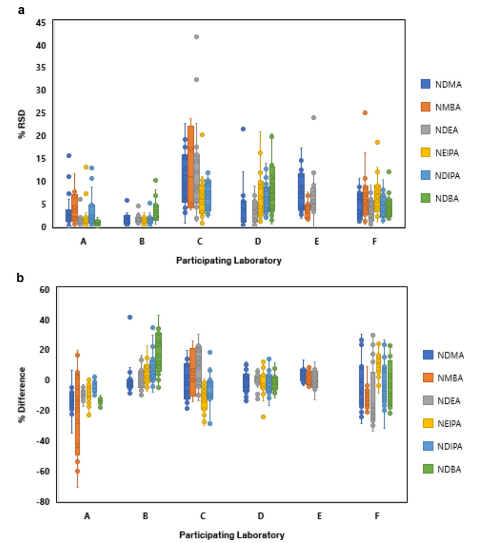
These findings underscore the significance of adapting analytical methods to match the distinctive characteristics of each sample type. These methods should be validated to ensure their suitability within specific measurement limits.

It’s vital to note that an analytical approach proven effective for analyzing nitrosamines in one medical product cannot be automatically considered valid for a different formulation.

Building on these findings, regulatory bodies and stake holders have initiated discussions about the criteria for evaluating MS-based analytical methods. Essential questions revolve around the acceptable level of variance that can be anticipated and considered reasonable for quantification using mass spectrometry.

Do you share similar uncertainties and inquiries about this subject?
7 Likes

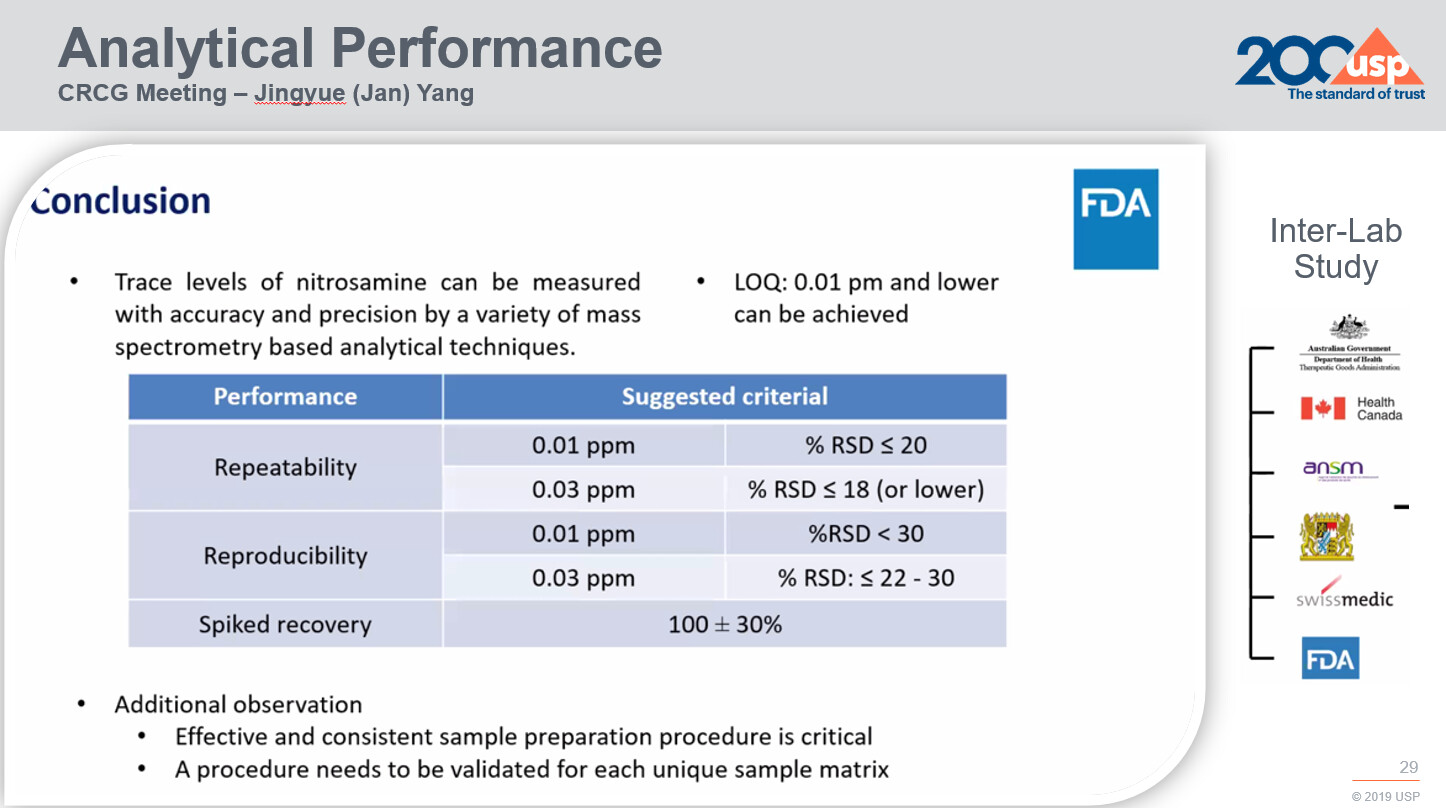
The information below was presented by FDA representative at recent CRCG meeting. Analytical Methods Performance suggested criteria

5 Likes

Dear is there a link to the full presentation?

Found it thanks

2 Likes

Presentation not downloading. Error occuring

Just need to search in past events… here is the updated link

3 Likes

Adding this post to the Feature topics, since I get many questions about the analytical performance characteristics of the methods for Nitrosamine testing
Open access!

3 Likes

What is rationale for criteria of less than 18, 20 and 30 %RSD?

@DrNagaraju, good question!

I would say that the rationale behind the <18%, <20%, and <30% %RSD criteria is not arbitrary, but it is also not a rigid regulatory standard.

These values are based in two complementary sources:

  1. Empirical data from a six-agency interlaboratory study which evaluated MS-based methods across FDA, Health Canada, ANSM, Swissmedic, LGL, and TGA. In that study, 96% of repeatability %RSD values fell below 15% for spiked samples, with the highest observed value reaching 18.4% at 0.01 ppm (near the LOQ). For reproducibility, 87% of values were below 20%, and 96% below 30%, again, with the worst case occurring at the lowest concentration tested.

  2. The Horwitz function: At 0.01–0.03 ppm, the range most relevant for nitrosamine control, Horwitz predicts reproducibility %RSD of 27 - 32% and repeatability of 18 - 21%. The observed data aligned closely with these predictions.

So the criteria are essentially a description of what was observed, not a prescriptive target set from first principles.

However and this is the critical point:

These numbers were generated under controlled interlaboratory conditions, using spiked samples, with nitrosamines added to solution (not genuinely embedded in the matrix). As the same study clearly showed, contaminated (authentically spiked) samples produced significantly higher variability, with 45% of reproducibility %RSD values exceeding 30%, compared to only 4% for spiked samples.

This tells us something fundamental: the variability you observe is not just a property of your method. It is a property of the analyte/matrix/technique system.

For nitrosamines analyzed by LC-MS, the sources of variability are multiple and often underestimated (matrix effects, in-situ formation during extraction, analyte instability and volatility losses during concentration steps, ionization variability etc).

Before accepting any %RSD value, or any criterion, as meaningful, you need to understand what is driving your variability. A method showing 25% reproducibility %RSD may be perfectly fit for purpose if that variability is well-characterized and controlled. A method showing 12% may be misleading if it is generating artifactual results.

The <18/20/30% %RSD benchmarks are useful orientation points, not pass/fail thresholds to be applied mechanically. The real question: does your method accurately reflect the true nitrosamine content in your specific matrix?

5 Likes

Fantastic explanation!