Recrystallization can stop nitrosamine formation in ranitidine hydrochloride - ScienceDirect
ABSTRACT
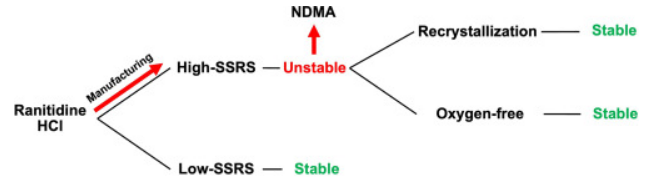
Nitrosamines, first identified in the 1950s as carcinogenic contaminants in food, tobacco, and industrial chemicals. Among them, N-nitrosodimethylamine (NDMA) is particularly dangerous due to its high carcinogenicity and frequent occurrence in drug products, such as ranitidine hydrochloride. Recent studies indicate that NDMA formation in solid-state ranitidine hydrochloride is driven by solid-state reactive species (SSRS), such as crystal defects, amorphous regions, and other high-energy sites within the drug crystal. In this paper, we demonstrate that NDMA formation in ranitidine hydrochloride can be essentially stopped by reducing the presence of SSRS in the drug substance through recrystallization. Well-controlled recrystallized ranitidine hydrochloride resulting in high-quality crystals exhibited significantly lower NDMA formation compared to as-received material when stored at 60°C and <2% relative humidity. Cryoground samples showed substantially increased reactivity, whereas subsequent well-controlled recrystallization restored stability, confirming the critical role of crystal quality. In contrast, poorly controlled recrystallization produced low-quality crystals with elevated SSRS, leading to higher degradation rates. These results eventually motivated us to test the role of oxygen in the degradation of ranitidine hydrochloride. Cryoground ranitidine hydrochloride samples exhibited minimal reactivity under vacuum or nitrogen, elevated reactivity in air (∼21% oxygen), and the highest nitrosamine formation in an oxygen-rich environment. These results suggest that well-controlled crystallization producing high-quality crystals may be an extremely effective method to inhibit nitrosamine formation, as SSRS are needed to promote reactivity, and could be an alternative and/or complementary approach to the current strategy of adding antioxidants and/or pH modification to formulations to minimize nitrosamine formation.