Something in the air−Unveiling the role of atmospheric nitrogen oxides in nitrosamine formation from amine-containing APIs: Mechanistic insights and risk assessment - Journal of Pharmaceutical Sciences
Highlights
•Significantly higher reactivity of API free bases compared with their salts
•NOx is a risk for false positive results in analytical testing of small drug samples
•Manufacturing steps involving forced airflow present elevated risk
•API storage under typical conditions poses a very low risk for NOx-mediated nitrosation
•Nitrosation is proposed to occur via solution-phase reactions in residual moisture and via gas-solid surface reactions
Abstract
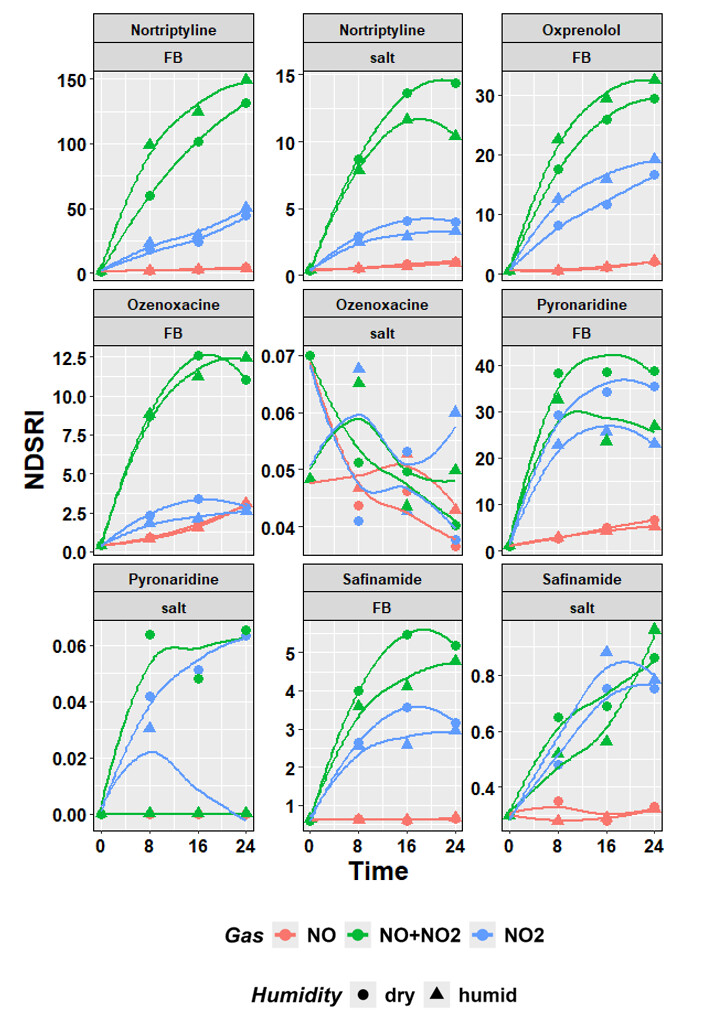
Atmospheric nitrogen oxides (NOx) have emerged as a potential contributor to nitrosamine formation in active pharmaceutical ingredients (APIs) containing vulnerable amines. This study investigates the extent and mechanisms of NOx-mediated nitrosation under controlled conditions and evaluates its relevance to real-world scenarios during API manufacturing, storage and analysis. Five structurally diverse APIs were exposed to NO, NO₂, and their mixtures at concentrations representative of urban air and forcing conditions. Nitrosamine formation was confirmed for all free base APIs, whereas corresponding salts exhibited significantly lower reactivity. Overall conversion was poor, with only ∼3% of available NOx consumed, even under high humidity and elevated NOx levels. Mechanistic analysis suggests two pathways: solution-phase nitrosation in residual moisture and gas-solid surface reactions, with NO/NO₂ mixtures forming N₂O₃ as the most potent nitrosating species. Ambient air experiments revealed that small, open samples are most susceptible, while bulk storage poses minimal risk due to NOx depletion and limited replenishment. These findings highlight the importance of considering NOx exposure during analytical handling and certain manufacturing steps involving forced airflow, while supporting a low risk for typical API storage.
9 Likes
I’ve been digging through that massive new collaborative paper from Lek, Merck, AstraZeneca, and Pfizer about atmospheric NOx and nitrosamine formation. I know we are all incredibly busy with confirmatory testing right now, so if you don’t have time to read the whole thing, here is the reality check we all needed.
This research finally separates the theoretical panic from what is actually happening on our lab benches and factory floors. Here are the critical findings you need to know:
-
Free Bases are the Main Culprit: There is a massive difference in reactivity depending on the state of your amine. Free base forms consistently showed a much higher nitrosation potential than their corresponding salts. In fact, reactivity varied by more than three orders of magnitude across the tested APIs.
-
The “Lab Bench” Trap: Leaving tiny analytical samples sitting out in open dishes is a surprisingly huge risk. Because the ratio of NOx in the air to the tiny amount of API is so favorable, these small samples can generate meaningful amounts of nitrosation just by sitting there. If we aren’t protecting our samples during prep, we could be creating false positives that don’t reflect the actual safety of our bulk materials.
-
Bulk Storage is Safe: You can breathe a sigh of relief about your commercial API storage. The studies showed that ambient NOx gets rapidly consumed right at the surface layer of larger samples. Because ambient air has such low levels of NOx, it just can’t replenish fast enough to penetrate deeper into the bulk material. But a word of caution, because it assumed 'low levels of NOx, and ‘properly’ stored
-
The Actual Danger Zones: While bulk storage is fine, the real risks lie in manufacturing steps that actively blast forced air through the product. Unit operations like jet milling and fluidized bed drying are where we need to be paying close attention, especially for highly reactive APIs.
As before, a wonderful work led by @schlinjo1975 @OlivierDirat et al.
11 Likes
Thank you, Naiffer! We have one more NOx paper in the pipeline, which will deal with NOx risk for bulk and finished drug products. Q4 2026, with a little bit of luck 
8 Likes