Happy Friday? Yes indeed! @Nitrosamines_Analyzer @Nitrosamines_Explorer @Nitrosamines_Investigator @Nitrosamines_Mitigator
Remember this from FDA guide?
Recovered Solvents, Reagents, and Catalysts as Sources of Nitrosamine Impurities.
Recovered materials such as solvents, reagents, and catalysts may pose a risk of nitrosamine impurities due to the presence of residual amines (such as trimethylamine or diisopropylethylamine). If the recovery process involves a quenching step (i.e., nitrous acid used to decompose residual azide), nitrosamines could form during solvent recovery. These nitrosamines may be entrained if they have boiling points or solubility properties similar to the recovered materials, depending on how recovery and subsequent purification takes place (e.g., aqueous washes or distillation).
Or this from EMA?
Risk factors related to GMP aspects:
- Use of contaminated recovered or recycled materials (e.g. solvents, reagents and catalysts) where the recovery is outsourced to third parties who are not aware of the content of the materials they are processing. Recovery processes carried out in non-dedicated equipment should also be considered.
Peter Ritzler, Holger Bauer, Michael Burns, Brunhilde Guessregen, Andrés González de Castilla, Stephanie Peper, Naiffer Romero, Joerg Schlingemann, Jonathan Stanway, Simone Tomasi … Took the challenge of going deep into understanding the industrial solvent recovery processes and defining the true risk of carrying nitrosamines during solvent recovery. (Thanks @schlinjo1975 for the honor!)
Theoretical and Experimental Assessment of Nitrosamine Risk in Industrial Solvent Recovery
Abstract:
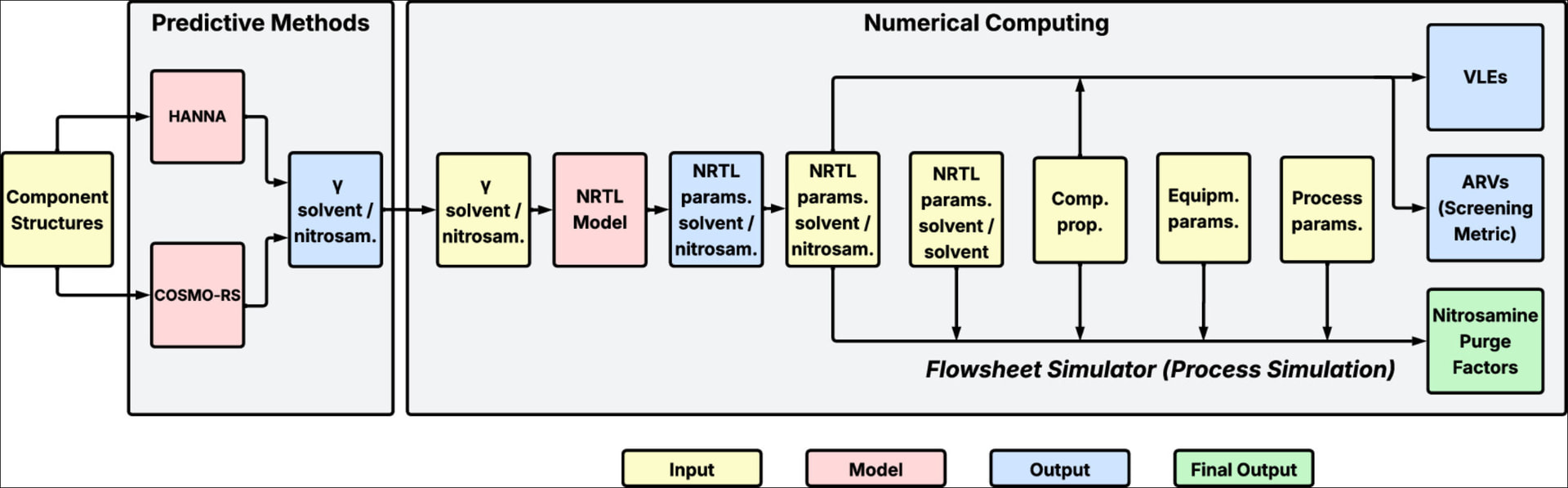
The recovery of solvents in pharmaceutical manufacturing offers substantial sustainability benefits but raises concerns about the potential carryover of mutagenic impurities, particularly N- nitrosamines (hereinafter: nitrosamines). This study presents a validated, comprehensive framework for in-silico assessment of nitrosamine risk in industrial solvent recovery processes by distillation. Its application was demonstrated exemplarily using three small molecule nitrosamines and 32 commonly used solvents. The proposed procedure consists of vapor–liquid equilibria (VLE) prediction, followed by risk estimation using a newly introduced key performance indicator (KPI), and detailed risk assessment using process simulation. Two state-of-the-art methods for nitrosamine-solvent VLE prediction were tested and successfully validated. The average relative volatility (ARV), as a KPI for separation efficiency, was shown to be suitable for estimating the risk of nitrosamine-solvent combinations. A Monte Carlo simulation demonstrated that ARVs ≥3 reliably predict nitrosamine purge factors exceeding 1000, supporting safe reuse in most cases. Nitrosamine risk for specific recovery processes can be assessed quantitatively by obtaining nitrosamine purge factors from process simulation. In a case study, this procedure was applied to an industrial acetonitrile recovery process, showing complete nitrosamine removal. Lab-scale distillations confirmed these findings. Overall, the results support a science-based, process-specific risk assessment strategy for solvent recovery, addressing regulatory concerns and enabling safer, more sustainable practices.
Access: https://pubs.acs.org/doi/10.1021/acssuschemeng.6c02602
 Great job!