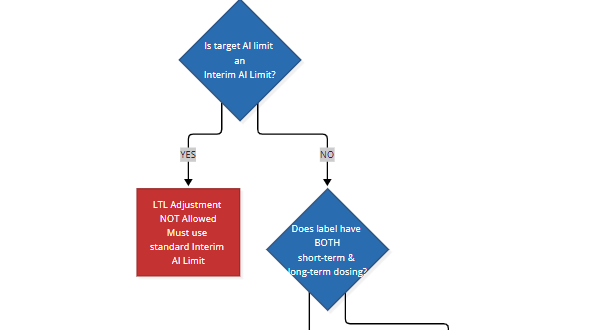
Dear Naiffer thank you for your efforts. Figure is really nice.
One question from my side.
Why LTL adjustment is not applied for all cases? I mean, even an interim limit is set, its duration is for 3 years (in line with GLs). However, this guidance provide a robust scientific justification on why LTL could be applied for AI derivation. So, I cannot see the point why industry could not claim the reg updates, even if an interim limit has been previously granted based on R/B assessment.
2 Likes
I think that, and Naifer can correct me if I’m wrong, the flowchart considers that an interim limit has already been proposed based on the exposure assessment and the risk evaluation, assuming a higher AI, and sometimes already considering LTL approach. Therefore, adding an LTL on top of that may not be appropriate…
1 Like
@elenipoliti thanks for the comment. As @JoaoGerheim pointed out, the intention is preventing that LTL is applied two times, if someone is using a temporary limit.
Should we change how the option is presented to make it more clear?
3 Likes
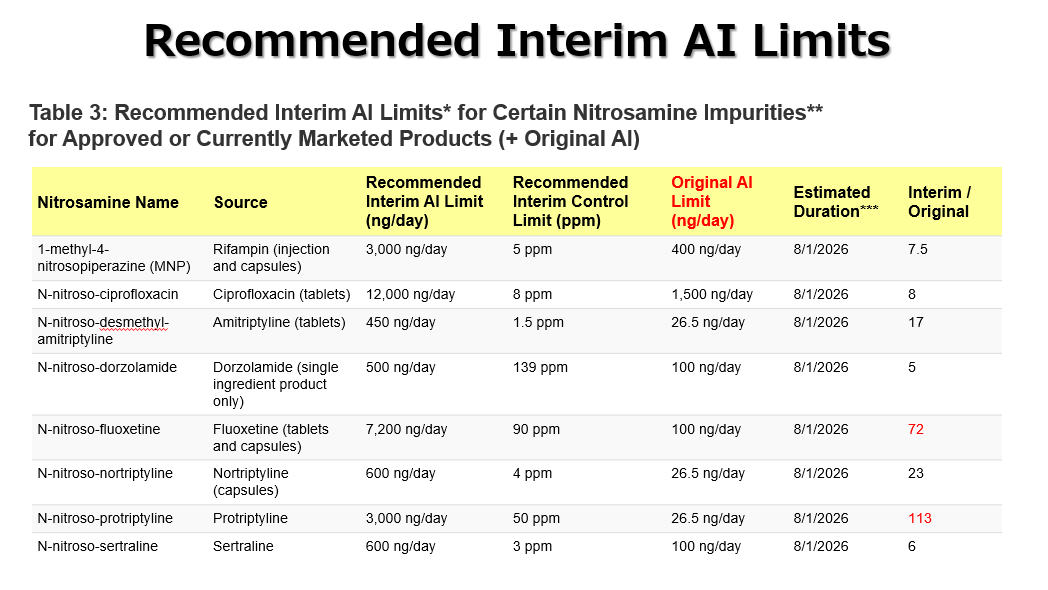
I have attached a table that I prepared about a year ago comparing the FDA’s Interim Limits with the original Limits. The Interim Limits were established taking into account not only safety but also actual contamination levels in finished products to help avoid supply shortages.
Since the Interim Limits have already been adjusted, I do not think it is appropriate to make an additional adjustment based on treatment duration.
2 Likes
I don’t think it is necessary to include an option to choose whether to use an Interim Limit as the acceptable intake.
If it were me, I would start by determining the duration of treatment, referring to Table 4 of ICH M7(R2).
As I read it, involved in regulatory, I understood that if AI is set/ agreed with HAs based on interim LTL, then till completion of 3y period, MAH is not allowed to revise the spec.
Perhaps a footnote as “LTL is applicable to AI as derived originally by CPCA - or something like that” could be beneficial.
1 Like