For your information new guidance from US FDA on LTL adjustments for nitrosamines:
This guidance represents the current thinking of the Food and Drug Administration (FDA or Agency) on this topic. It does not establish any rights for any person and is not binding on FDA or the public. You can use an alternative approach if it satisfies the requirements of the applicable statutes and regulations.
Wow! Right?
First time FDA surprises industry in the good way.
Lets see if this is a sneak peek at what ICH M7 harmonization will bring… or if EMA will align soon.
Great. This goes a step further than the application of LTL during CAPA, which is supported by the EMA. The important point is that the FDA will accept requests for consultation on the application of LTL and determine its acceptability on a case-by-case basis.
I found the link and information on the CDER page.
Application of Less-Than-Lifetime (LTL) Adjustment to Nitrosamine Impurities
The recommended AI limits in Tables 1 and 2 of this webpage reflect recommended lifetime AI limits that approximate an increased cancer risk of one additional case in 100,000 people. This risk is based on a conservative assumption of daily exposure to the impurity over a lifetime (70 years). As described in the Application of Less-Than-Lifetime Adjustment to Nitrosamine Impurities, consistent with the LTL framework described in International Council for Harmonisation (ICH) guidance for industry, M7(R2) Assessment and Control of DNA Reactive (Mutagenic) Impurities in Pharmaceuticals to Limit Potential Carcinogenic Risk (July 2023), LTL adjustment factors may be applied to recommended lifetime AI limits for nitrosamine impurities in drug products intended for a less-than-lifetime duration of treatment. Refer to the Other Emerging Scientific and Technical Issues section of this webpage for LTL adjustment factors for individual nitrosamine impurities (see September 24, 2026: Application of Less-Than-Lifetime Adjustment to Nitrosamine Impurities).
* Chemical structure images provided by the National Institutes of Health/National Center for Advancing Translational Sciences.
In addition, a new footnote was added to Tables 1 and 2.
1 The recommended AI limits in this table were determined based on lifetime exposures. Refer to the Application of Less-Than-Lifetime Adjustment to Nitrosamine Impurities update on the Other Emerging Scientific and Technical Issues section of this webpage for additional information on adjustment factors for less-than-lifetime use.
Great initiative by FDA and well explained, @Yosukemino !
I would like to understand whether the application of LTL is limited only to FDA-listed nitrosamine impurities, or if it can also be applied to nitrosamine impurities that are accepted/listed by other regulatory authorities such as EMA and Health Canada. Additionally, can LTL be applied to nitrosamine impurities for which the AI has been established through CPCA-based calculations?
From what I have seen, FDA has been the most conservative concerning LTL application. Other agencies have accepted its application to clinical materials, for example. So, one could and should try. The manner in which the limit has been derived is not of consequence in the application of the LTL adjustment.
After the initial overreaction, when virtually all nitrosamines were viewed through the same lens as NDEA, and then the CPCA phase introduced in 2023, it finally feels like we can breathe again. This guidance brings us much closer to the original spirit of ICH M7 and a genuinely risk-based approach. Full harmonization is still ahead of us, and it will be interesting to see how other regulatory authorities respond.
Thanks for sharing, and special thanks to all those who invested time and effort in generating the data and scientific rationale behind this evolution. It’s encouraging to see good science ultimately reflected in regulatory thinking.
There is one point regarding this topic that I am not entirely clear about.
My understanding is that, according to the EMA nitrosamine guidance, the LTL approach can only be applied to newly identified nitrosamines that have subsequently been added to the relevant list. I had therefore understood the LTL approach as a temporary measure that could be applied during the CAPA process until an appropriate permanent control strategy is established.
My first question is whether my understanding of the EMA approach is incorrect.
Secondly, does the FDA apply the LTL approach independently of the situation described above? For example, can the LTL approach also be applied to an established nitrosamine such as NDMA, regardless of whether it has been newly identified or added to the relevant list?
In my understanding, the LTL approach was essentially a gap between ICH M7 and the nitrosamine Q&A, arising from the lack of sufficient data. Considering that nitrosamines fall under the scope of ICH M7, and as we move towards further harmonization of ICH M7, the HESI position supporting the LTL approach, which the FDA appears to be embracing, seems to bridge this previously existing gap.
I do not think that the LTL approach would be applicable only to new nitrosamines or new products. At least, if it is intended to follow the same rationale as the LTL of the TTC approach in ICH M7, I would expect it to have a broader applicability.
FDA CDER released guidance establishing that Less-Than-Lifetime (LTL) adjustment factors based on ICH M7(R2) can be applied to acceptable intake (AI) limits for nitrosamine impurities in human drug products intended for short-term or intermittent administration.
Key Findings:
CDER shifted its long-standing stance, moving from excluding nitrosamines from ICH M7 LTL adjustments to aligning with ICH M7(R2) principles.
Evidence from two publications (Felter et al., 2025/2026; HESI Nitrosamines Research Program) demonstrated that carcinogenic risk follows cumulative dose-response, mitigating prior concerns regarding cellular DNA repair saturation and polypharmacy.
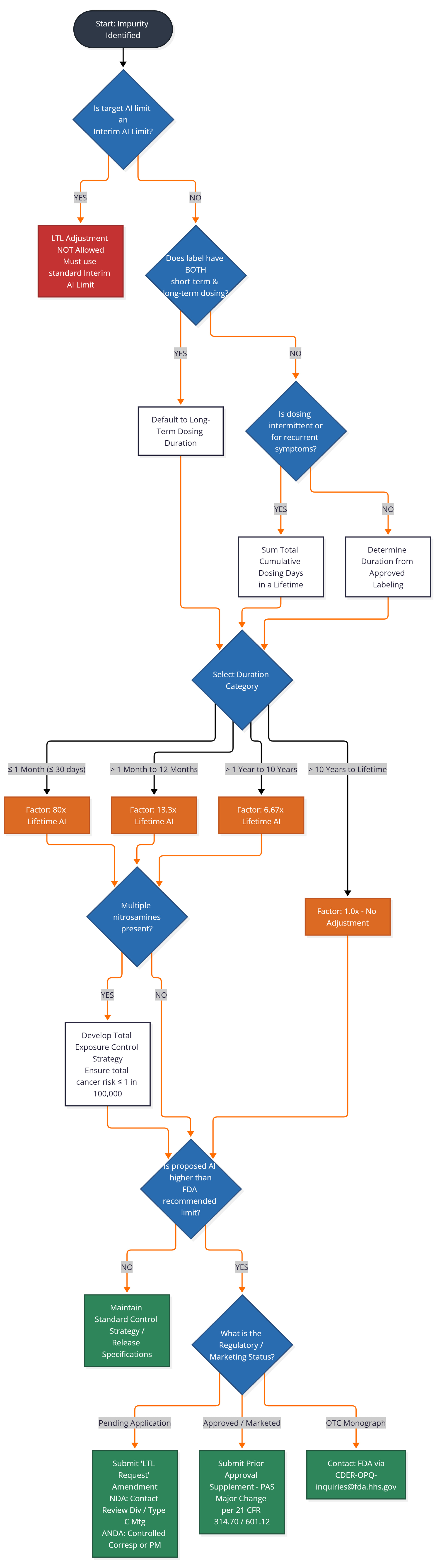
Recommended adjustment factors apply to daily AI limits based on labeled clinical duration: 80x (≤1 month), 13.3x (>1–12 months), and 6.67x (>1–10 years).
LTL adjustments apply strictly to lifetime AI limits and are explicitly prohibited for interim AI limits.
Multi-nitrosamine limits and intermittent dosing regimens must calculate total lifetime cumulative exposure days against the corresponding duration tier.
Outcome:
Acute and short-course therapeutics (e.g., anti-infectives, short-term analgesics) now have a clear regulatory pathway for higher temporary impurity thresholds.
Regulators evaluate duration based on labeled indication; products with dual acute/chronic indications or recurrent dosing must be benchmarked against total long-term exposure.
For marketed products, adopting an LTL-adjusted limit is considered a major change requiring a Prior Approval Supplement (PAS).
The 10% AI threshold for omitting specifications or relying on annual reports applies relative to the approved control strategy, meaning LTL adoption requires full regulatory re-evaluation.
Uncertainties remain around how CDER will handle edge cases, such as patient switching between therapies or off-label long-term use of short-course medications. Case-by-case review via PAS or formal Agency meetings is required, leaving open questions on submission timeline impacts for pending applications.
How are your regulatory affairs teams evaluating pending ANDA/NDA applications for acute therapeutics against the new PAS requirement?
What challenges do you foresee in calculating cumulative dose days for intermittent or PRN (as needed) treatment schedules?
FDA, September 24, 2026: Application of Less-Than-Lifetime Adjustment to Nitrosamine Impurities
The scientific conclusion that the cancer risk from nitrosamine impurities is consistent with a cumulative dose response relationship and that the concerns previously identified regarding DNA repair capacity and polypharmacy do not preclude an LTL adjustment when appropriate safeguards are in place
As we continue digesting the new development from the agency, a few questions emerge specifically from the ‘Applicability of LTL adjustment factors’ section
LTL adjustment factors requires accurate characterization of the intended treatment duration as reflected in approved labeling
Duration of treatment used to determine the applicable adjustment factor is consistent with the labeled indication and dosing regimen
If a drug product label includes dosing instructions for both short-term and long-term use, CDER generally intends to consider long-term use in calculating the LTL-adjusted AI limit
For intermittent dosing or treatment of recurrent symptoms, the LTL-adjusted AI limit should be based on the total number of dosing days
For drug products with multiple nitrosamines, applicants should propose a control strategy for total exposure to nitrosamine impurities
Examples of Clinical use scenarios with different treatment durations [reference table 4 from ICH M7 (R2)]
Scenario
Acceptable Intake (µg/day)
Treatment duration of < 1 month: e.g., drugs used in emergency procedures (antidotes, anesthesia, acute ischemic stroke), actinic keratosis, treatment of lice
120
Treatment duration of > 1-12 months: e.g., anti-infective therapy with maximum up to 12 months treatment (HCV), parenteral nutrients, prophylactic flu drugs (~ 5 months), peptic ulcer, Assisted Reproductive Technology (ART), pre-term labor, preeclampsia, pre- surgical (hysterectomy) treatment, fracture healing (these are acute use but with long half-lives)
20
Treatment duration of >1-10 years: e.g., stage of disease with short life expectancy (severe Alzheimer’s), non-genotoxic anticancer treatment being used in a patient population with longer term survival (breast cancer, chronic myelogenous leukemia), drugs specifically labeled for less than 10 years of use, drugs administered intermittently to treat acute recurring symptoms2 (chronic Herpes, gout attacks, substance dependence such as smoking cessation), macular degeneration
10
Treatment duration of >10 years to lifetime: e.g., chronic use indications with high likelihood for lifetime use across broader age range (hypertension, dyslipidemia, asthma, Alzheimer’s (except severe Alzheimer disease), hormone therapy (e.g., growth hormone, thyroid hormone, parathyroid hormone), lipodystrophy, schizophrenia, depression, psoriasis, atopic dermatitis, Chronic Obstructive Pulmonary Disease (COPD), cystic fibrosis, seasonal and perennial allergic rhinitis, HIV3
No more AI infographics of the new guide… (it seems these days Linkedin is full of those)
This is my attempt to provide a decision tree diagram based on the new LTL framework for Nitrosamines… let me know if it is useful or need any adjustments