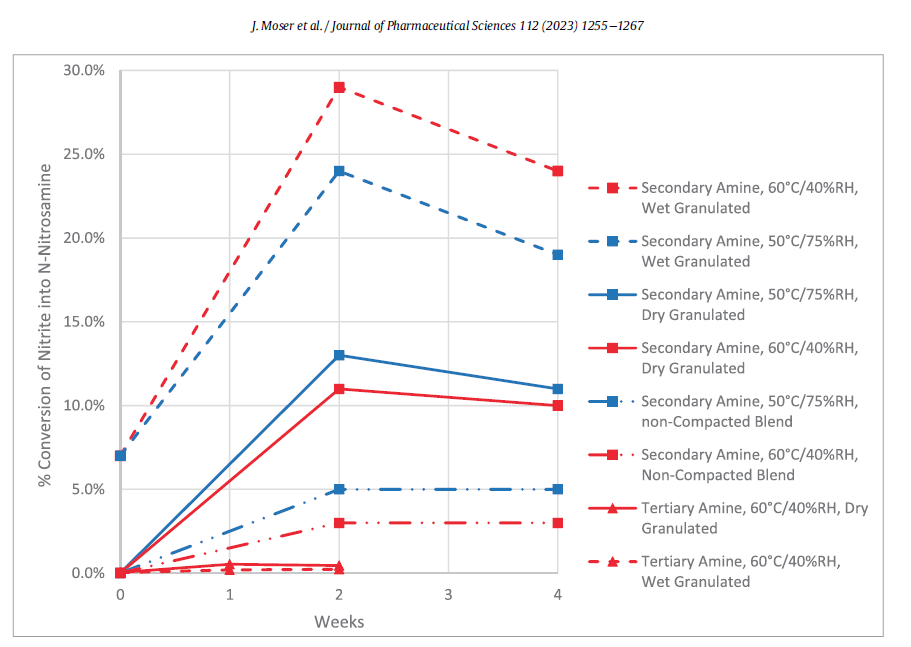
we mostly receive nitrosmaine test results laying much below the theoretical calculated ones due to the very conservative approach to use maximum nitrite values from LHASA database. We are searching now for an alternative approach to use conversion factors, derived from literature such as from Moser et. al:
I have been using the conversion factor approach proposed by Moser et al. in my nitrosamine risk assessments. In practice, I apply the conversion percentages reported in Table 7 and select the worst-case conversion scenario that best matches the specific product characteristics, such as wet granulation versus direct compression, secondary versus tertiary amines, hydrochloride salts versus free bases, etc. The paper demonstrated that nitrosamine formation in solid dosage forms is significantly lower than the theoretical 100% conversion typically assumed in worst-case assessments, with a maximum observed conversion of approximately 38% under the most critical conditions
From my experience, this approach has been accepted by ANVISA in Brazil when supported by a sound scientific justification. I have successfully used both the conversion-factor approach from Moser et al. and more refined kinetic models as alternatives to the very conservative assumption of complete nitrite conversion.
However, I would highlight an important caveat. For some higher-risk APIs, ANVISA has not always accepted nitrite values derived solely from databases or even from IPEC supplier questionnaires. In several cases, the agency has requested either:
Analytical results for the specific nitrosamine of concern; or
Experimental nitrite data for each excipient used in the theoretical calculation.
Therefore, my experience is that theoretical calculations are generally accepted, including more realistic approaches based on conversion factors or kinetic models. However, this acceptance comes with important reservations, and for critical cases the agency may still require experimental data to support the assessment.
Overall, I have found the Moser conversion-factor approach to be a useful and scientifically justified refinement of the initial theoretical calculations, provided that it is applied conservatively and with appropriate product-specific justification.
Dear @tassiloh. Just to highlight, if you intend to leverage the publication by Moser et al., your scenario must be demonstrably more conservative than the one described in the paper. This means that key parameters should be equal to or more stringent than those reported in the publication, such as an equal or higher pKa of the susceptible amine, equal or lower levels of the vulnerable amine, equal or lower nitrite content per tablet, and comparable or less favorable conditions for nitrosamine formation. Otherwise, the comparison cannot be considered sufficiently conservative to support your case. Finally, but that is a risk to be evaluated, the matrix used in the publication would not be equal to yours, and the stability study was performed for 1 month, not the full shelf life of common pharmaceutical products. In any case, it could work but should this considerations be taken into account.
I believe the best approach is to find a balance between these conversion factors which I also use (especially the one published by Moser et al.) and the experience observed in previous products with similar structures, excipients, and behavior.
Considering the high variability in nitrite content among batches of excipients from different suppliers and, even from the same supplier, the best approach would be to analyze the nitrites in all excipient batches. Another option to save time and resources would be to use theoretical values based on your previous analyses from your supplier, but in this case, it would be advisable to be somewhat more conservative (using slightly higher values) to avoid surprises arising from a batch with higher-than-expected nitrite levels and to repeat the analyses periodically.
These theoretical approaches are very useful for nitrosamines derived from impurities; however, based on experience, when the nitrosamine comes from the API itself, I would always recommend performing confirmatory analyses, as it is difficult to predict its behavior given that many factors may cause variability and there is a risk of exceeding the corresponding limit. Therefore, unless the product has a very high limit that is easy to justify theoretically, when the API forms the nitrosamine, it is best to perform confirmatory analyses.
Very well put, Diego, the agencies are hestitant to accept this kind of comparison, because, as you said, the bigger nitrosamines behave very differently from each other in different matrices. I have tried for clients with little success to use this justification and I understand why. When I was in the FDA, I would have possibly not accepted it as a standard argument.
When I first started working with nitrosamines, I believed that a thorough theoretical assessment would be sufficient to mitigate the risk in virtually all cases. With the experience and maturity I have gained over the years, I now see things somewhat differently.
Theoretical approaches are extremely important, and Step 1 risk assessment is essential for designing a robust analytical strategy in Step 2. A good theoretical evaluation helps focus efforts on the most relevant risks, establish appropriate limits, and identify nitrosamines that are genuinely plausible based on the chemistry of the product.
However, when the secondary or tertiary amine is the API itself, I consider analytical confirmation to be indispensable. There are risks that cannot be fully mitigated or even predicted through theory alone. For example, nitrite carryover from unexpected sources, variability in raw materials, manufacturing-related factors, or other nitrosating agents that may not be identified during the initial assessment.
In several cases, even after performing a detailed root-cause investigation and implementing formulation or process changes to reduce nitrosamine formation, it is still difficult to fully explain the source of the nitrosating contamination. This is why I generally prefer to perform at least an exploratory analytical study for APIs containing critical secondary or tertiary amines, to understand the actual state of the product rather than relying exclusively on theoretical assumptions.
To support prioritization, I have been using a risk-ranking matrix that combines:
The nature of the amine (API-derived vs. impurity-derived);
Whether the corresponding nitrosamine has an established regulatory limit;
The criticality of that limit (<18 ng/day, 18–100 ng/day, 100–400 ng/day, 400–1500 ng/day, >1500 ng/day).
Combined with the theoretical formulation assessment, this approach allows me to triage products and identify which ones deserve a more in-depth analytical investigation.
In my experience, this strategy has helped balance scientific rigor, resources, and patient safety while avoiding both underestimation and overestimation of nitrosamine risk.
This study evaluates the formation risk of active pharmaceutical ingredient (API) fragment nitrosamine drug substance-related impurities (NDSRIs) derived from secondary amine related impurities that may be present in human drug products throughout their shelf life. Leveraging publicly available data from the Food and Drug Administration (FDA) Global Substance Registration System (GSRS), the carcinogenic potency categorization approach (CPCA), and available maximum daily dose (MDD) information, they identified 446 secondary amine related impurities linked to 218 individual APIs in human drug products. It is stated, that based on internal research efforts by Office of Pharmaceutical Quality at FDA, a conversion ratio range between 0.001% and 0.5% was established.
Has anybody an idea, how I could get the following information:
where can I review the list of 446 secondary amines from the 218 APIs? I think, this ia a very important information.
where can I get the information about how the conversion ratio range was established? Our expierience with conversion factors are deviating.