In the March 2026 update of the EMA Appendix 1 (Acceptable Intakes for N‑nitrosamines), N‑nitroso‑methylethylamine (NMEA) is listed as a potential impurity associated with Amphotericin B.
However, based on a comparison of the chemical structure of Amphotericin B (a complex polyene macrolide) and NMEA (a simple low molecular weight dialkyl nitrosamine), there does not appear to be an obvious structural relationship or common secondary/tertiary amine precursor within the API itself.
Could anyone provide insight into the mechanistic rationale for this association? For example:
-
Is the proposed origin linked to specific synthetic steps, degradation pathways, or manufacturing reagents/solvents rather than the API structure itself?
-
Or could this be an example where the listed “source” reflects a potential risk scenario (e.g., external amine/nitrosating agent combination) rather than a structure-derived impurity?
I would appreciate any clarification on whether this linkage is chemically justified or if it might reflect a conservative or generic assignment in the EMA table.
4 Likes
I am facing the same question. Based on the assessment conducted so far, Amphotericin B is produced by fermentation, and reagents such as dimethylformamide (DMF) and triethylamine are used during the purification steps. Both can act, directly or indirectly, as sources of amines susceptible to nitrosation, particularly in the presence of nitrosating agents.
From a mechanistic perspective, it is plausible to consider that these amines, originating from solvents or process reagents, could give rise to nitrosamines such as N-nitrosomethylethylamine (NMEA), even in the absence of a direct structural relationship with the API. In this context, the formation of NMEA would be associated with process-related contamination rather than being an intrinsic degradation product of Amphotericin B.
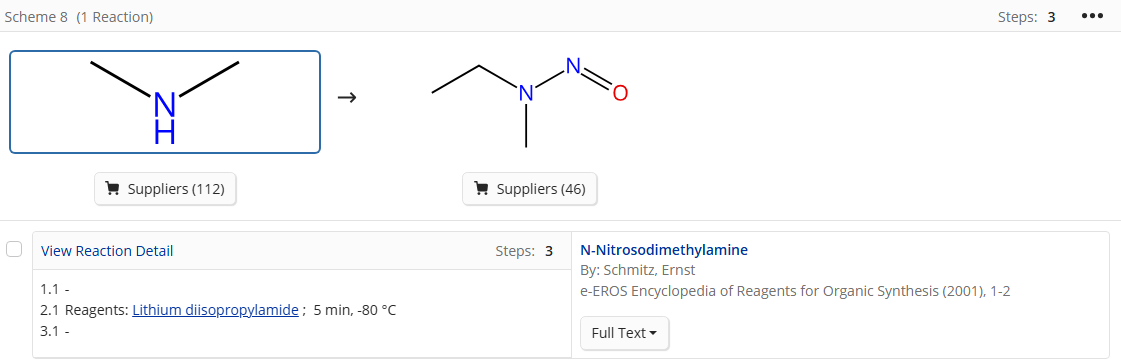
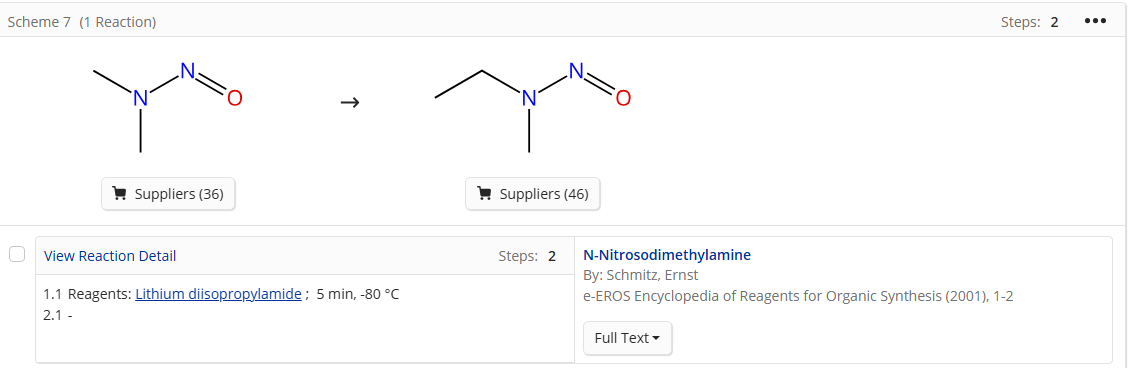
An exploratory assessment was performed using Zeneth software to investigate the potential formation of NMEA from DMF and triethylamine; however, NMEA was not predicted as a degradation product under these conditions. Additionally, a SciFinder retrosynthetic analysis identified some synthetic routes starting from dimethylamine or even NDMA, but these involve highly reactive conditions (e.g., the use of sodium hydride or organolithium reagents), which limits their relevance in a typical industrial purification setting.
Overall, the most consistent hypothesis at this stage is that NMEA, when associated with Amphotericin B, represents an exogenous nitrosamine, potentially arising from the combination of residual process amines with nitrosating agents, rather than an impurity derived from the API structure itself. This also suggests that its inclusion in the EMA table may reflect a conservative, risk-based approach rather than a well-established specific formation mechanism.
These considerations are speculative, based on the use of the two reagents mentioned above. One possibility is that NDMA and NDEA were initially being investigated in the product, and due to their structural similarity to NMEA, the formation of this additional nitrosamine may have also been detected.
3 Likes
if this is not a typo error, this could only related with the presence of an amine relative to ΝΜΕΑ in the synthesis of the amphotericin.
Do you have asked the API manufacturer for this case?
There is no relation of NMEA with DMF and/or triethylamine, as it was also proved from Zeneth evaluation although this software usually gives an the ‘‘exotic’’ impurities along with the anticipated.
thanks,
Christos
3 Likes
I think this is related to the solvent used during purification, as mentioned by @mayrlaache
I haven’t confirmed it in the amphotericin B ROS, but TEA is likely used in purification steps, as in other fermentation processes.
Contamination of TEA with N‑methylethanamine might occur because it is a byproduct of the same industrial alkylation process. As a result, they may remain as impurities in the solvent. The same applies to diethylamine. So it will depend on the quality of the solvent, I don’t see why this would be associated specifically with amphotericin B.
2 Likes