I am honored to be able to share information from Japan about the impact of NOx in the atmosphere during pharmaceutical manufacturing. Of course, this is not my achievement, but the result of the efforts of many excellent researchers in Japan. According to reports, reducing NO2 is very effective in preventing nitrosamines that are formed due to the NOx in the atmosphere during manufacturing. Not less than 90% of NO2 can be reduced by a filter for NOx removal.
Thank you for asking. I am sorry I did not hear the presentation. Because UV light has low transparency and because excipients are generally used in large amounts, we believe that care must be taken with the irradiation method.
Dear Yosuke,
could you please elaborate on the phrase ‘‘care must be taken’’? what exactly do you mean with this? Is there any risk we should focus on?
thanks
Dear Christos,
When we perform photo stability tests of API with UV light, we adjust the powder height to less than 3mm. And color change of API may happen on the surface of API. It means that degradation happens mainly on the surface.
To effectively reduce NO2 in excipients using UV light, it is necessary to devise a method for uniformly irradiating the excipients with UV light. I am not sure how realistic their methods are. This is why I am interested in what they did in reality.
i got your point, thanks Yosuke.
I agree, the uniform irradiation would be a challenge.
This could be feasible if there was a ‘‘fluid bed’’ type reactor with the excipient blend inside and an outside UV source to irradiate the suspended excipient particles.
anyway, please keep us ‘‘update’’ on this
best regards
Christos
According to the presentation materials, the excipients were placed in petri dishes or trays and exposed to UV light under specific conditions (e.g., 10 W/m², 20 h). A high reduction effect was observed for excipients containing a large amount of NOx by UV irradiation. It’s interesting.
That’s quite a low power UV at 10W/square meter - stability cabinets I was looking at yesterday were 1W/square centimeter.
The 20 hours and needing be to be in a petri dish to get sufficient surface area make me wonder how to scale to something commercial - many tens or even hundreds of kg of microcrystalline cellulose seems a difficult job to do.
Do the speculate on the chemistry involved with the UV light and the nitrite/NOx? Or specific wavelengths?
The wavelength of UV light used in the experiment was 360 nm. This may be a good option for excipients that contain a lot of nitrite but are used in small amounts.
I agree with you. I am sending a question to the PMDA to clarify the selection criteria for nitrosamines in the list. I will share the answer in the future.
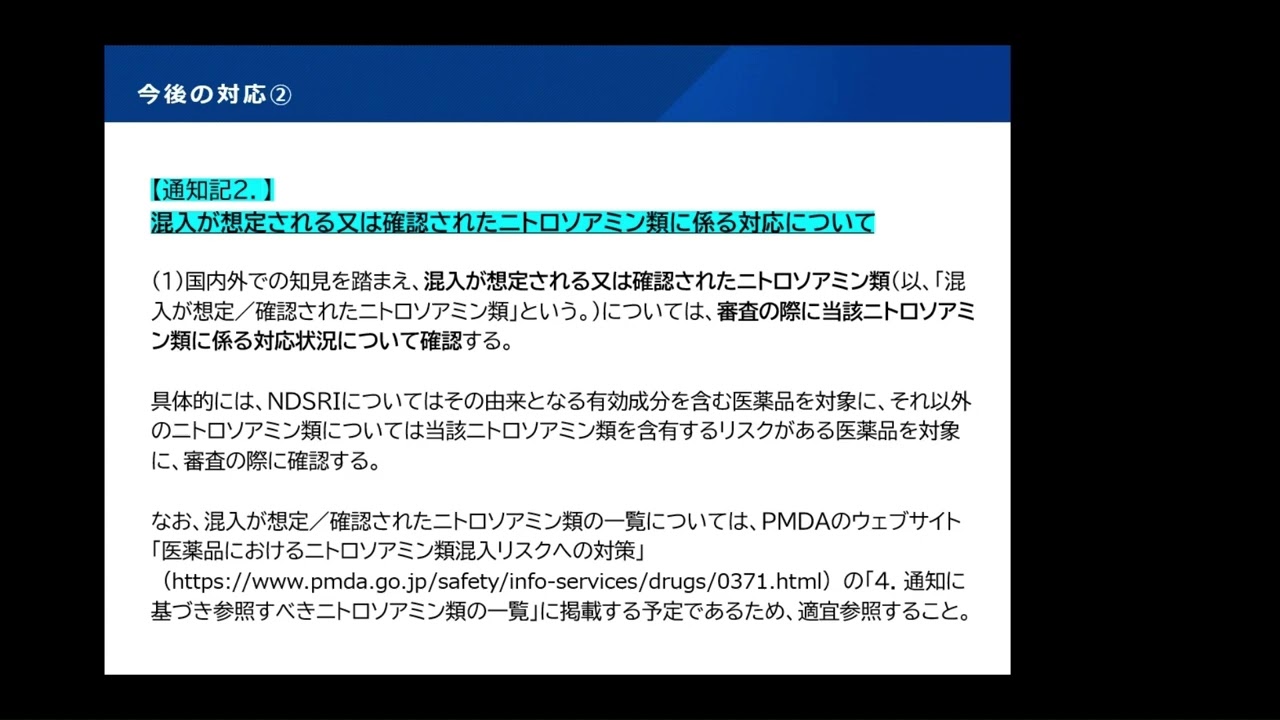
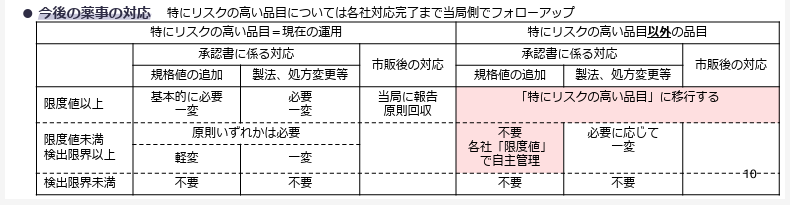
I am sorry for my late reply, Christos. I asked ChatGPT to translate the document into English. Because this concerns regulations in Japan, it is rather detailed and a bit difficult to follow.